
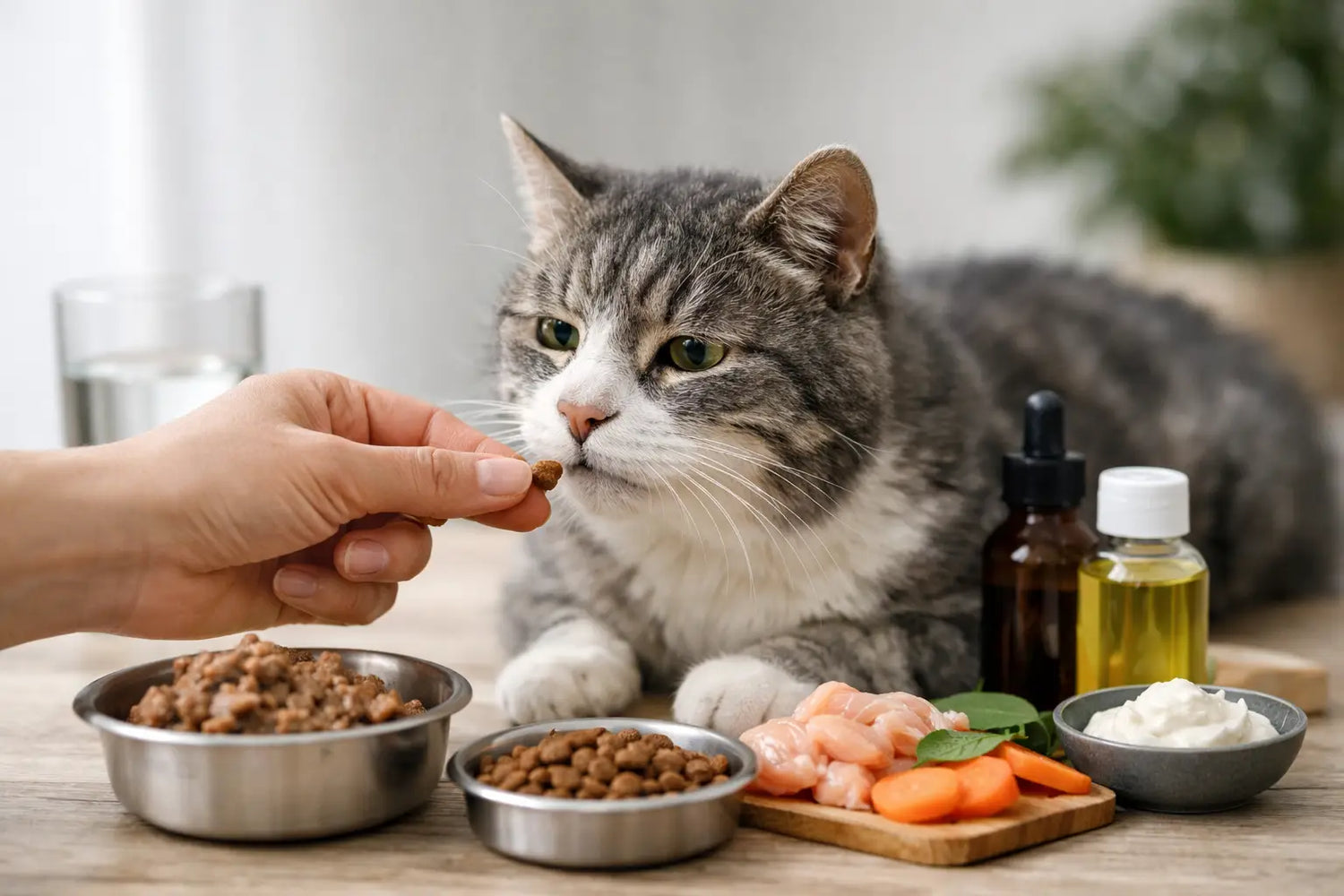
When your kitty starts sleeping more, jumps less on the sofa, or becomes more selective at the bowl, the question immediately arises: what to give an elderly cat to really help them? It’s not enough to just pick a "senior food" at random. With age, digestion, muscle mass, hydration, mobility, and the ability to cope with daily stresses change. That’s why targeted, concrete support suited to their health condition is needed.
What to give an elderly cat: where to really start
An elderly cat doesn’t just need to eat less or consume fewer calories. Often, they need to eat better, absorb nutrients better, and receive more precise functional support. Some cats tend to lose weight, others gain weight because they move less. Some drink little, others develop greater digestive or joint sensitivity. The point is this: there is no one-size-fits-all answer.
The foundation is always a complete, palatable, and easily digestible diet, with good quality proteins and adequate moisture content. Hydration is very important for senior cats, so wet food is often a useful ally, especially if the cat tends to drink little. Alongside nutrition, nutraceutical supports come into play, which can make a difference when stiffness, fatigue, general tone loss, or increased fragility begin to appear.
Senior cat nutrition: less improvisation, more observation
One of the most common mistakes is thinking all elderly cats have the same needs. In reality, a 10-year-old cat still active and with a good appetite is very different from a 15-year-old cat who eats little, loses muscle mass, or moves cautiously. That’s why the choice of what to give an elderly cat should be based on observing concrete signs.
If the kitty leaves food in the bowl, there may be a palatability issue, but also oral discomfort or less efficient digestion. If they seem stiffer in movement, joint support may become a priority. If the coat is duller or recovery after minor stresses is slower, working on metabolism and liver support can be helpful.
At this stage, meal consistency and frequency also matter a lot. Small portions spread throughout the day are often better tolerated than one large meal. Food that is too cold may be less appealing, while a soft texture helps cats with sensitive teeth or delicate gums.
When supplements are needed for the elderly cat
Supplements don’t replace a balanced diet but can become valuable support as the body ages. Senior cats are more exposed to joint wear, low-grade inflammation, vitality decline, and increased sensitivity of excretory organs, including the liver.
This is where well-formulated nutraceuticals make sense. It’s not about filling the cat with products. It’s about choosing functional ingredients that work in synergy, with a clear logic and a precise goal.
Support for joints and mobility
Many elderly cats don’t limp obviously. They simply change habits: avoid jumping, climb on furniture more hesitantly, groom less well in the lower back area because they bend their backs less. These signs deserve attention.
In these cases, ingredients like Perna canaliculus, Boswellia serrata, Devil’s claw, and Spirulina can offer interesting support. Perna canaliculus is known for its content of glycosaminoglycans and bioactive lipids, useful for joint health. Boswellia is studied for its support in inflammatory processes, while Devil’s claw is often used to support joint function. Spirulina adds rich and complete nutritional support.
In a formula like Artricur pet, these actives are combined with Aloe arborescens, black carrot, beetroot, and orange carrot. Aloe arborescens and carrot, especially when cold-processed to preserve active principles, add important functional value in daily general wellness management. For an elderly cat showing stiffness or less desire to move, this kind of support can help make movements more comfortable day by day.
Liver and metabolic support
With age, the liver continues to do enormous work: nutrient metabolism, waste management, overall body balance. When the cat is elderly, supporting liver function can be a smart choice, especially during periods of fluctuating appetite, fatigue, or prolonged therapies evaluated with the veterinarian.
Among the most appreciated ingredients is milk thistle standardized in silymarin, widely studied for its antioxidant role and liver support. Alongside this, substances like betaine, zinc, resveratrol, and B vitamins contribute to energy metabolism and cellular well-being.
A formulation like Epapet is designed with this logic: to offer targeted nutraceutical support for liver function and general metabolism. It can be particularly useful in a senior cat during times of general slowdown or when working preventively, always within a thoughtful plan.
Not just food: daily comfort also matters in the elderly cat
Often, those looking for what to give an elderly cat think immediately of the bowl, but a senior kitty’s well-being also involves skin, eyes, ears, and paws. A cat that grooms less well can more easily develop localized discomfort, secretion buildup, or small irritations.
For example, the eyes may need more regular cleaning, especially if the cat is less thorough in cleaning its face. A solution with aloe, chamomile, cornflower, and witch hazel, like Oftocur, helps gently cleanse a very sensitive area.
The same applies to the ears. If the cat tends to produce more earwax or shows discomfort when touched, proper ear hygiene with soothing and cleansing ingredients like aloe, calendula, propolis, coconut oil, and tea tree oil can help maintain balance in the area. An ear cleanser like Otorì meets this routine need well.
Skin also deserves attention. In old age, it can become more delicate, less elastic, more prone to dryness or localized redness. Aloe, carrot, calendula, propolis, and other dermo-functional actives are useful because they work naturally on protection and skin comfort. If the cat has dry paw pads or areas stressed by licking, specific products like Zampet, Dermogel, or Dermospray can be practical and effective support.
How to tell if you’re giving your elderly cat what it needs
The answer isn’t just in weight. Watch how it moves, how curious it is, if it approaches food with interest, if the coat stays neat, if it sleeps peacefully, and if it maintains its little habits. A well-cared-for elderly cat doesn’t become a kitten again but can stay vital, present, and comfortable much longer.
However, there is one essential point: if the cat eats much less, loses weight, drinks much more than usual, vomits often, or changes behavior sharply, don’t stop at the supplement. A veterinary evaluation is needed. Natural supports work best when introduced at the right time and for the right need.
A comprehensive approach is always the most effective
Managing a senior cat rarely resolves with a single action. Usually, the best result comes from combining wet, palatable food, weight control, targeted nutraceutical support, and a gentle hygiene routine in the most sensitive areas. It’s daily work, but very concrete.
That’s why well-formulated natural remedies play an increasingly central role. Aloe arborescens, carrot, Perna canaliculus, Boswellia, milk thistle, calendula, chamomile, and propolis are not ingredients thrown together as a trend. When carefully selected and processed, they represent real help in supporting the elderly cat’s body without weighing it down unnecessarily.
Those who live with a senior kitty know this well: it’s not about doing a lot, it’s about doing the right thing consistently. And when you see them moving more freely again, letting themselves be petted calmly, and approaching the bowl with pleasure, you know you’re on the right track. Aloeplus Dogs and Cats works precisely on this: turning concrete needs into natural, specialized, and easy-to-use supports to accompany every elderly cat with more comfort and quality in their daily routine.
The best gift at this age is not filling the bowl randomly but choosing what truly makes them feel good.