
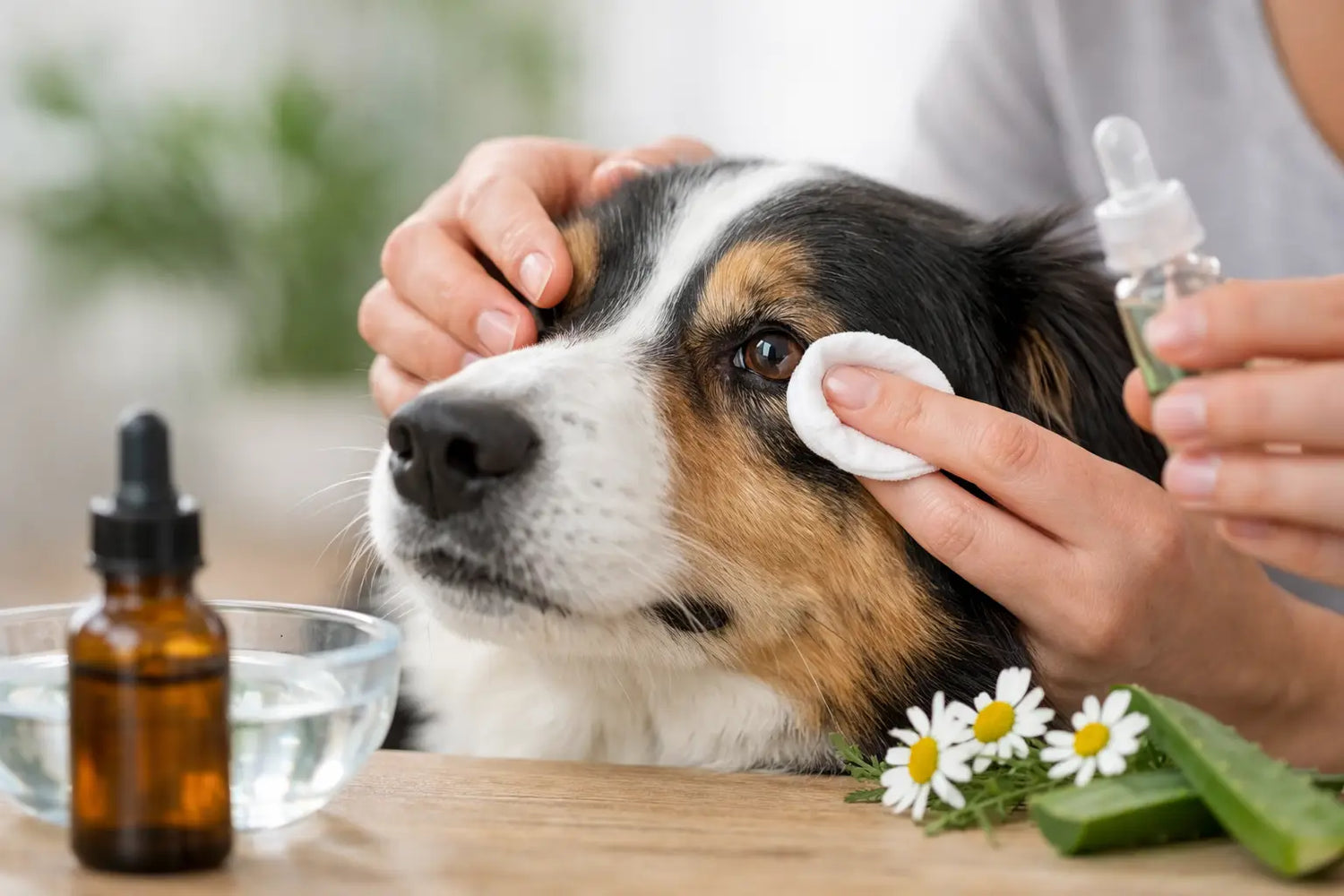
A dog’s eyes shouldn’t be cleaned only when “they look dirty.” If you notice crusts at the corners in the morning, more tearing than usual, or slight redness after a windy walk, acting promptly and properly makes a difference. When looking for how to clean a dog’s eyes with a natural solution, the key is not to use something generic, but to choose a gentle cleanser suitable for the eye’s mucous membrane that effectively removes secretions, dust, and residues without causing irritation.
The eye is a sensitive area, exposed daily to pollen, dust, temperature changes, and rubbing from paws. For some dogs, this is an occasional issue; for others, it’s recurring—think of brachycephalic breeds, dogs with more protruding eyes, those with pronounced facial folds, or those prone to excessive tearing. In these cases, eye cleaning is not just cosmetic but an essential part of daily care.
When to clean a dog’s eyes with a natural solution
Not every secretion is a warning sign, but none should be ignored. A small amount of watery or mucous material at the inner corners can be normal, especially upon waking. It’s different when secretions are abundant, thick, yellowish or greenish, when the dog squints, shows obvious discomfort, itching, light sensitivity, or marked redness. Cleaning helps here but does not replace a vet’s evaluation.
For daily routine, washing a dog’s eyes with a well-formulated natural solution is useful when there’s dust after outdoor activities, mild irritation from external agents, a tendency to form crusts or tear stains, or simply to keep the eyelid margin clean. Gentleness matters more than you might think: unsuitable products, makeshift DIY remedies, or non-specific substances can disrupt the area’s balance or cause more discomfort than they solve.
Cleaning dog’s eyes: natural solution yes, but which one?
The word “natural” is reassuring but not enough on its own. Eye hygiene requires a formulation designed specifically for that area, with ingredients known for soothing and cleansing effects and a high tolerance profile. Not everything natural is safe for use in or near the eye, and this is where confusion often arises.
A good natural solution for a dog’s eyes should help cleanse without stinging, soften secretions, promote comfort around the eye area, and support the mucous membrane’s natural protection. Ingredients like aloe, chamomile, cornflower, and witch hazel are valuable because they combine gentleness with effectiveness.
Aloe is valued in dermatology for its moisturizing and soothing action. Chamomile is traditionally used to calm mild irritations, while cornflower is known in cosmetics and eye hygiene for its refreshing and softening effects. Witch hazel is often chosen for its calming effect on skin and delicate areas. The difference lies in the quality of the formulation and the fact that the product is developed for veterinary use, not roughly adapted from other purposes.
The most common mistakes in cleaning a dog’s eyes
The first mistake is using homemade remedies without care. Tap water, homemade infusions, non-sterile gauze, or non-specific cleansers may seem harmless shortcuts but can introduce impurities, have uncontrolled concentrations, or be too harsh for the eye.
The second mistake is rubbing. Dry secretions should be softened and removed gently, without rubbing the eyelid or dragging residue across the eye surface. The third is underestimating frequency: if the dog often has tearing, redness, or relapses, the underlying cause needs to be identified. Allergies, anatomical conformation, misdirected eyelashes, foreign bodies, or tear film problems require precise diagnosis.
There is also a common misconception: if the dog doesn’t complain, it’s nothing. In reality, many dogs tolerate discomfort without showing obvious signs. That’s why observing small daily signals is as important as choosing the right product.
How to properly clean a dog’s eyes
The procedure should be simple and low-stress. Start by creating a calm moment, preferably always in the same place and with clean hands. Apply the solution to a soft gauze or suitable pad, then gently clean from the inner corner outward, without reusing the same dirty side. If there are crusts, it’s better to let them soften for a few seconds before removing them.
If the product is formulated for veterinary eye cleansing, it can be used regularly when the dog needs it. This is a real advantage for dogs prone to accumulating secretions or easily irritated after environmental exposure. Consistency in these cases is more valuable than occasional aggressive cleaning.
Why aloe, chamomile, cornflower, and witch hazel make sense
When talking about effective natural remedies, credibility comes from matching the problem with the ingredients. In dog eye cleansing, the goal isn’t to “cure everything” but to help keep the eye clean, comfortable, and less exposed to mechanical irritation from secretions and residues.
Aloe is one of the most interesting active ingredients for its moisturizing and soothing properties on skin and mucous surfaces. Scientific literature on Aloe vera and related species describes activities related to tissue protection, hydration, and support of physiological repair processes, although results depend greatly on extract quality and formulation. Chamomile contains compounds studied for their calming properties. Cornflower is valued for its traditional use in preparations for sensitive eyes, while witch hazel is appreciated for the comfort it brings to red or reactive areas.
This is where the value of a specialized veterinary formulation comes in. In an eye cleanser like Oftocur, the combination of aloe, chamomile, cornflower, and witch hazel provides a concrete response to a daily need: to clean well and gently, without weighing down the process with unnecessary ingredients or improvised approaches. For those who see their dog as a family member, this is not a technical detail but a true protection choice.
When a natural solution is enough and when it’s not
It’s practical to acknowledge that not all eye problems can be solved by cleansing alone. If the dog keeps the eye closed, has pain, purulent discharge, corneal opacity, swelling, trauma, or worsens within a few hours, a vet is needed. A natural solution is useful for hygiene and mild discomfort from external agents but should not delay diagnosis when signs indicate something more serious.
At the same time, waiting too long with minor issues can worsen the condition. If secretions stagnate, fur stays damp, and the periocular area becomes irritated, the dog tends to rub more, creating a self-perpetuating cycle. Proper cleansing breaks this cycle.
The right routine for more sensitive dogs
For predisposed dogs, eye cleaning should become part of the routine along with checking ears, paws, and skin. Excess is not needed, but regularity is. After countryside outings, windy days, dusty environments, or high pollen periods, a gentle eye cleanser can reduce residue buildup and improve comfort almost immediately.
Age also matters. Older dogs may more easily have secretions or difficulty managing the eye area normally. For puppies, gentleness is even more important. In both cases, a well-formulated natural solution is preferable to makeshift remedies.
Cleaning a dog’s eyes with a natural solution: the smartest choice is a specific one
Those looking to clean a dog’s eyes naturally often want to avoid harsh products but not sacrifice effectiveness. This is a perfectly legitimate request. The best answer is not DIY but a veterinary eye cleanser that uses natural actives with a clear function and tolerance suitable for frequent use.
In this spirit, Aloeplus Cani e Gatti offers a solution like Oftocur, formulated with aloe, chamomile, cornflower, and witch hazel specifically to cleanse and soothe the delicate eye area. It’s the approach that best reflects conscious daily care: natural yes, but with a specialist, concrete, and results-oriented foundation.
Taking care of your dog’s eyes doesn’t require complicated steps. It requires attention, gentleness, and choosing what truly respects such a sensitive area. Often, well-being starts here: from cleaning done well, at the right time, with the right solution.