
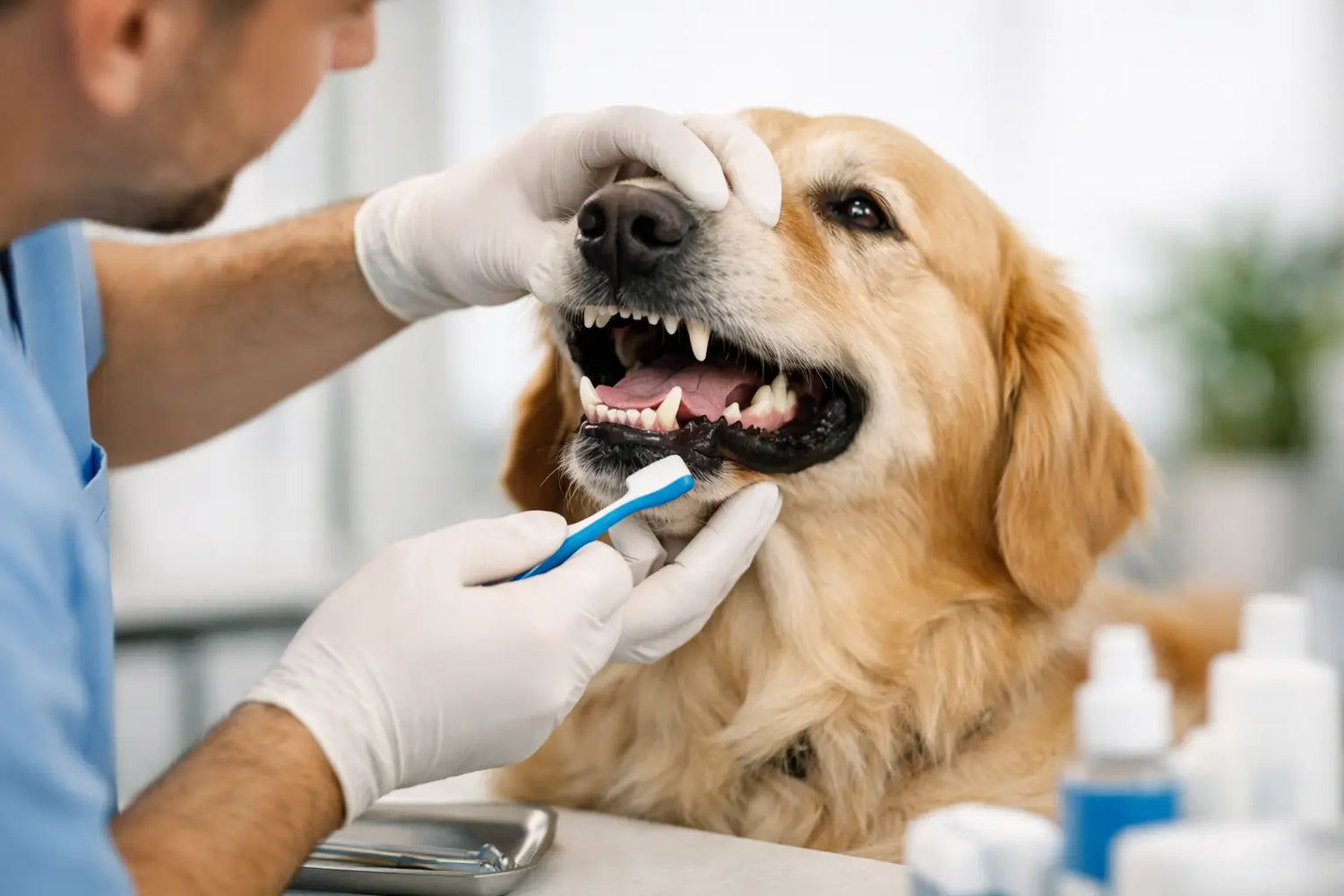
When a dog eats less, chews only on one side, drops food, or suddenly has stronger breath than usual, the problem is often not “just a bit of tartar.” In many cases, it’s time to consider targeted oral support for dogs, capable of helping gums, mucous membranes, and oral comfort before the discomfort becomes more serious.
The point is this: a dog’s mouth affects overall well-being, appetite, and quality of life much more than is commonly believed. Persistent oral irritation can make it difficult to eat, drink, play with chew toys, and even accept contact on the muzzle. For those who see their dog as a family member, recognizing the signs early means intervening sooner and more effectively.
Oral support for dogs: what it really means
Talking about oral support for dogs doesn’t mean replacing the veterinarian or thinking every problem can be solved with a product. It means complementing the clinical visit and proper hygiene with a daily support strategy, useful when the dog shows gum sensitivity, redness, bad breath, discomfort while chewing, or a more reactive mouth than usual.
The oral cavity is a delicate environment. Bacterial plaque, chewing microtraumas, food residues, individual predisposition, age, and the animal’s general condition can disrupt its balance. In some dogs, the problem remains mild and occasional. In others, it tends to recur, with gum inflammation, irritated mucous membranes, and worsening oral odor.
This is where the value of a well-formulated natural support comes in: not a generic promise, but a concrete help to keep oral tissues in better condition, reduce discomfort, and support the physiological protection of the mucosa.
Signs not to underestimate
A dog with oral discomfort doesn’t always complain obviously. Often, it changes habits. It eats more slowly, avoids dry food, chews cautiously, refuses snacks it once loved. Sometimes it yawns frequently, licks its lips, rubs its muzzle with a paw, or holds its head slightly tilted when taking food.
Bad breath is a common warning sign, but it’s not the only one. Increased salivation, red gums, slight difficulty grasping food, or less interest in playing with chew toys also deserve attention. If the condition is marked, with obvious pain, bleeding, or loss of appetite, a veterinarian is always needed. Support makes sense when part of proper problem management, not when it delays diagnosis.
Why natural solutions can make a difference
Those seeking help for their dog’s mouth today are much more informed than a few years ago. It’s not enough to read “delicate” or “natural” on the label. People look for ingredients with a specific function, compatible with daily use, and formulated to act in a sensitive area like the oral cavity.
Scientific literature on some natural active ingredients is interesting. Aloe, for example, has been studied for its soothing properties and support for the physiological repair of tissues, including in the oral area. Several clinical and experimental publications have observed favorable effects on mucosal comfort and local inflammation control, although results depend on formulation and context of use. This is the key point: the ingredient alone is not enough; how it is selected, processed, and included in the product matters.
Carotenoids and antioxidant compounds found in carrots can also contribute to protecting tissues exposed to oxidative stress. In an environment like the mouth, where irritation and microbial load can combine, antioxidant support has an interesting rationale, especially if integrated into formulas designed for functional, not cosmetic, use.
Aloe Arborescens and carrot: the functional rationale
In managing oral support for dogs, Aloe Arborescens and carrot represent a coherent combination with a natural but serious approach. Aloe Arborescens is valued for its soothing, hydrating, and protective action on mucous membranes. When the mouth is sensitive, having an active ingredient that promotes better tissue condition can make a real difference in the dog’s daily life.
Carrot, in turn, provides functional compounds with antioxidant activity and a profile useful for supporting tissue trophism. The advantage of this ingredient pair is not a spectacular or immediate effect, but the ability to work on the biological basis of the problem: better-protected mucous membranes, improved local comfort, and support for the normal tissue response to daily stresses.
For this reason, when choosing an oral solution, it makes sense to prefer formulas that enhance the quality of raw materials and preserve active principles. A gentle processing method can greatly impact the final result.
When oral support is useful and when it is not
There are situations where oral support for dogs has a clear rationale. For example, in dogs prone to gum sensitivity, elderly dogs with more delicate mouths, after oral hygiene procedures as indicated by a veterinarian, or when aiming to maintain oral well-being in the presence of recurring bad breath or easily irritated mucous membranes.
However, it’s important not to oversimplify. If there is advanced periodontal disease, a fractured tooth, a mass, a foreign body, or significant stomatitis, support alone is not enough. In these cases, it is part of a broader management plan that may include a full oral examination, therapy, and professional treatments. The best choice is not “natural versus clinical,” but natural combined with proper veterinary evaluation.
How to choose a truly useful product
Many owners face many similar proposals that only appear alike. The real difference lies in specialization. A good product for oral support should not just freshen the mouth or temporarily mask bad breath. It should focus on tissue quality and the physiological protection of the mucosa.
Composition matters, but so does the formulation philosophy. A solution developed in the veterinary field, with attention to tolerability and the functionality of active ingredients, offers more guarantees than generic products created without a true focus on the dog’s oral well-being. Even better if backed by an approach that combines natural ingredients, clinical experience, and educational content aimed at the owner.
In this context, Aloeplus Cani e Gatti stands out for a very clear vision: starting from the pet’s concrete problem and building a targeted response, with functional ingredients like Aloe Arborescens and carrot, enhanced by a proprietary cold-processing HDR method designed to preserve active principles. This is not a minor technical detail. If the goal is to help a sensitive mucosa, the biological quality of the formulation matters.
What to expect in the right time frame
A common mistake is expecting a radical change in 24 hours. In oral support, the most useful results are often progressive. The dog may show improved comfort while chewing, less oral reactivity, milder breath, and better tolerance to hygiene routines. In mild cases, improvement can be quick. In more persistent conditions, consistency is needed.
It should also be said that every dog responds differently. Age, diet, individual predisposition, plaque load, chewing habits, and general condition influence the outcome. For this reason, it is important to observe the dog in real life: how it eats, how relaxed it is, if it returns to chewing with pleasure, if it better accepts contact around the muzzle.
A daily routine that truly protects
Oral support works best when part of a sensible routine. Proper nutrition, periodic mouth checks, attention to breath and gums, cleaning when possible, and well-chosen functional products work together. There’s no need to complicate the dog’s life with too many procedures. Continuity is key.
Those who live with a dog know how to recognize when something changes, even before obvious signs. That’s exactly where a protective and competent approach makes the difference: intervening early, choosing actives with a precise rationale, and focusing on formulas designed for animal well-being, not on improvised solutions.
Taking care of a dog’s mouth is not an aesthetic gesture. It’s a concrete way to protect its comfort every day, starting from what it uses most to experience the world: eating, playing, sniffing, interacting. And when the support is the right one, this difference really shows.