
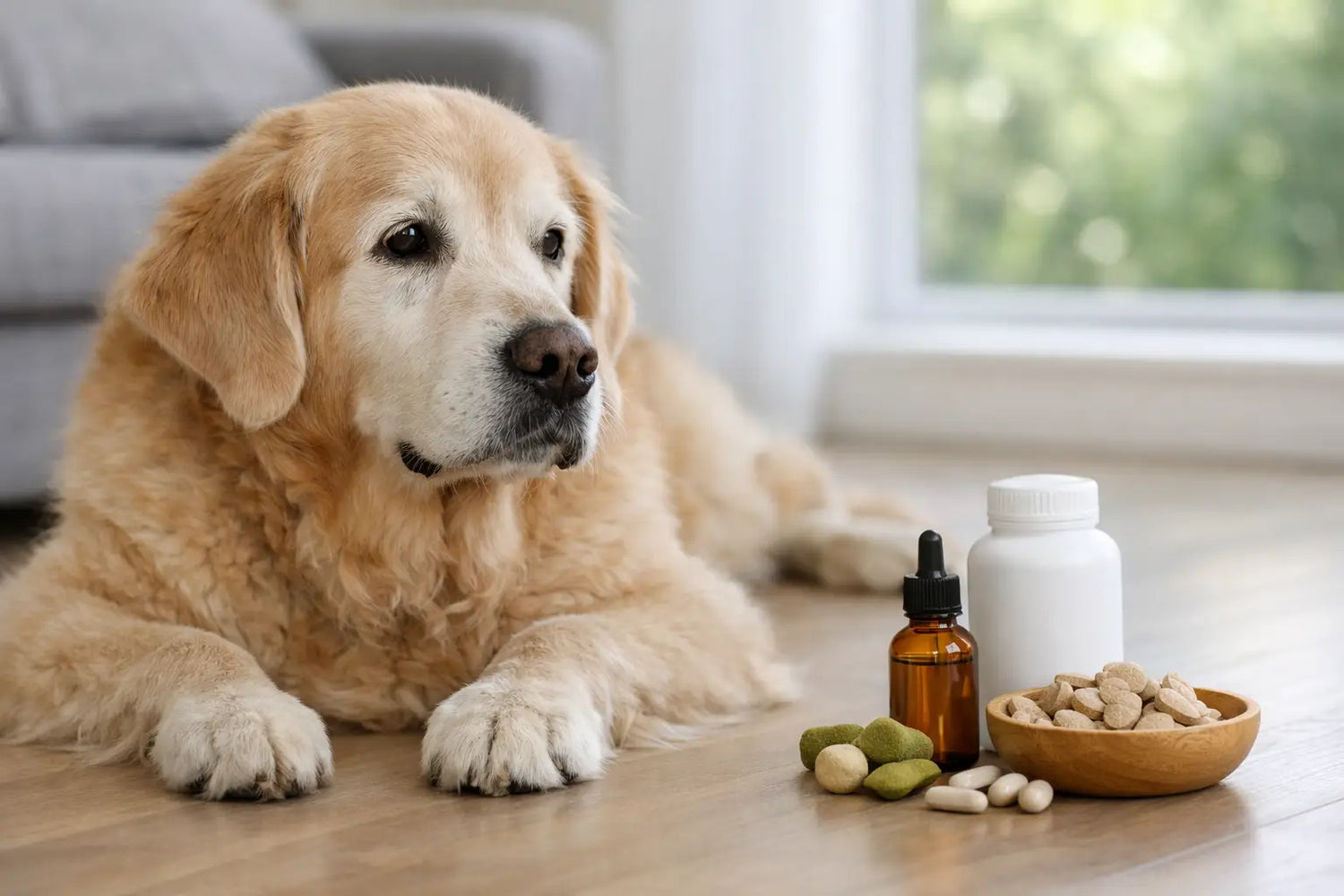
When an elderly dog hesitates before getting up, slows down on walks, or stops jumping on the couch, it is often not just “old age.” This is the time when a joint supplement for elderly dogs can become a real help, especially if chosen wisely and included in a daily routine of attention, consistency, and targeted support.
When a joint supplement for elderly dogs is needed
As dogs age, their joints face an increasingly difficult load to manage. Cartilage can lose elasticity, periarticular tissues become less efficient, and movement, once a natural gesture, begins to require more effort. Dogs do not always show pain clearly. More often, they change habits: climbing stairs slowly, lying down more often, avoiding intense play, and appearing stiff especially upon waking.
At this stage, waiting for the problem to become severe is not the best choice. A well-formulated nutraceutical support makes more sense when introduced at the first signs or even as prevention in predisposed subjects, such as large breed dogs, overweight dogs, or animals with a history of joint stress. The goal is not just to “make them move more,” but to help maintain comfort, fluidity, and quality of life.
What a good joint supplement should contain
Not all products are the same. When evaluating a supplement for an elderly dog, the quality of the formula matters much more than the generic name on the label. A good composition should support multiple fronts: the inflammatory response, the nourishment of joint tissues, protection from oxidative stress, and the overall well-being of the body.
Among the most interesting ingredients are those with chondroprotective functions, used to support the physiology of cartilage and connective structures. But alone, they are often not enough. In daily practice, a formula that also includes natural actives with antioxidant and balancing action is useful, because the elderly joint is never an isolated problem: it is a system under stress that benefits from broader support.
This is where the value of naturally selected ingredients with a precise veterinary logic comes into play. Aloe Arborescens, when properly processed to preserve its active principles, represents an interesting support in the context of overall well-being thanks to its richness in natural compounds useful for maintaining physiological balance. Carrot, in turn, naturally provides substances with antioxidant action that help counter oxidative stress, a factor that can also weigh on age-related degenerative processes.
For this reason, in a joint supplement for elderly dogs, it makes sense to prefer formulations that do not focus only on the single joint but on the biological environment in which that joint must function. This is a concrete difference, not just theoretical.
Why naturalness alone is not enough
Many owners look for a natural product, and this is an understandable choice. However, natural does not automatically mean effective. The quality of raw materials matters, how they are processed matters, and the consistency of the formula matters.
If the actives are delicate, the processing method can make the difference between a simply “green” product and a truly functional support. In the veterinary nutraceutical world, preserving active principles is central. A cold processing method, like the HDR method developed by Aloeplus Cani e Gatti, was born precisely from this need: to keep the functional component of natural ingredients like Aloe Arborescens and carrot as intact as possible, thus offering support more faithful to the raw material.
This aspect is often underestimated by buyers. They look at the ingredient name but do not assess whether that ingredient has been treated to preserve its value. For an elderly dog, who needs constant and well-tolerated support, this is a detail that is not just a detail.
How to tell if the support is working
A common mistake is expecting an immediate change. Joint supplements do not act like a one-time intervention. They work over time and require regularity. Usually, the first signs to observe are small but significant: the dog gets up with less hesitation, accepts slightly longer walks, seems more willing to move, and changes position less during rest.
Sometimes improvement is not measured by increased activity but by reduced fatigue in performing usual movements. And this has enormous value for an elderly dog. Naturally, it depends on the starting condition. If there is advanced joint degeneration, the supplement does not “solve” the problem but can become part of a useful strategy to support the dog daily.
For this reason, it is important to observe the dog as a whole. Not only how it walks but also how much it sleeps, how it relates, whether it seeks contact more or tends to isolate itself. Joint comfort affects emotional well-being more than one might think.
Joint supplement for elderly dogs and daily management
The right supplement works better if included in a consistent routine. Body weight, for example, is decisive. Even a few extra pounds can increase the load on hips, elbows, and spine. The same goes for the type of movement: regular and moderate activity is better than intense and sporadic efforts.
The home environment also helps or worsens the situation. Slippery floors, repeated jumps from the couch, or difficult access to resting areas can increase motor difficulty. Sometimes people immediately think of the product and neglect everything else. In reality, the best result comes from the sum of several correct choices.
In this context, a quality nutraceutical support has the advantage of being easy to administer and suitable for continuous use. It is continuity that makes the difference, especially in senior dogs who need to be accompanied day by day, not only in the worst moments.
When to start and when to seek veterinary advice
The most honest answer is: earlier than you think. There is no need to wait for obvious limping. If the dog has passed a certain age, belongs to a predisposed breed, or shows the first signs of stiffness, starting targeted support can be a sensible choice.
However, there are situations where consulting a veterinarian is essential. If the dog shows marked pain, sudden limping, significant difficulty getting up, tremors, loss of appetite, or rapid worsening, not everything should be attributed to aging. It is necessary to understand the cause and set up proper management.
The supplement does not replace a clinical visit but can effectively complement it. In fact, in the best veterinary strategies, the nutraceutical is included as complementary support, designed to work in the medium to long term with a good tolerance profile.
What to evaluate before purchasing
Those living with an elderly dog do not need generic promises. They need to know if a product is formulated for a real problem, if it uses ingredients with a clear functional logic, and if it can be easily administered every day.
It is worth reading the label carefully. A formula aimed at joint well-being should be transparent in composition and consistent in its proposal. The presence of natural ingredients with high functional value, such as Aloe Arborescens and carrot, is an interesting sign when included in a serious nutraceutical project, not just as a commercial appeal.
The specialization of the company also matters. A brand working in pet wellness with a veterinary focus, clinical cases, educational materials, and attention to production quality generally offers greater guarantees compared to improvised or too generic solutions. Buyers for an elderly dog seek trust even before the product, and this is a more than legitimate request.
The real goal is not to make them run more
Often joints are thought of only in terms of movement. In reality, the point is different: allowing the elderly dog to live its days well. To move without stiffening too much, rest better, face walks with more serenity, and maintain the desire to participate in family life. This is the result that really matters.
To achieve this requires a clear choice: a supplement designed with expertise, valuable natural ingredients, a well-preserved formulation, and a consistent routine. When these elements work together, the support is seen in the simplest gestures. And it is precisely there that a senior dog lets you understand how it feels.
Caring for their joints does not mean chasing youth but protecting their well-being with intelligence, respect, and consistency.