
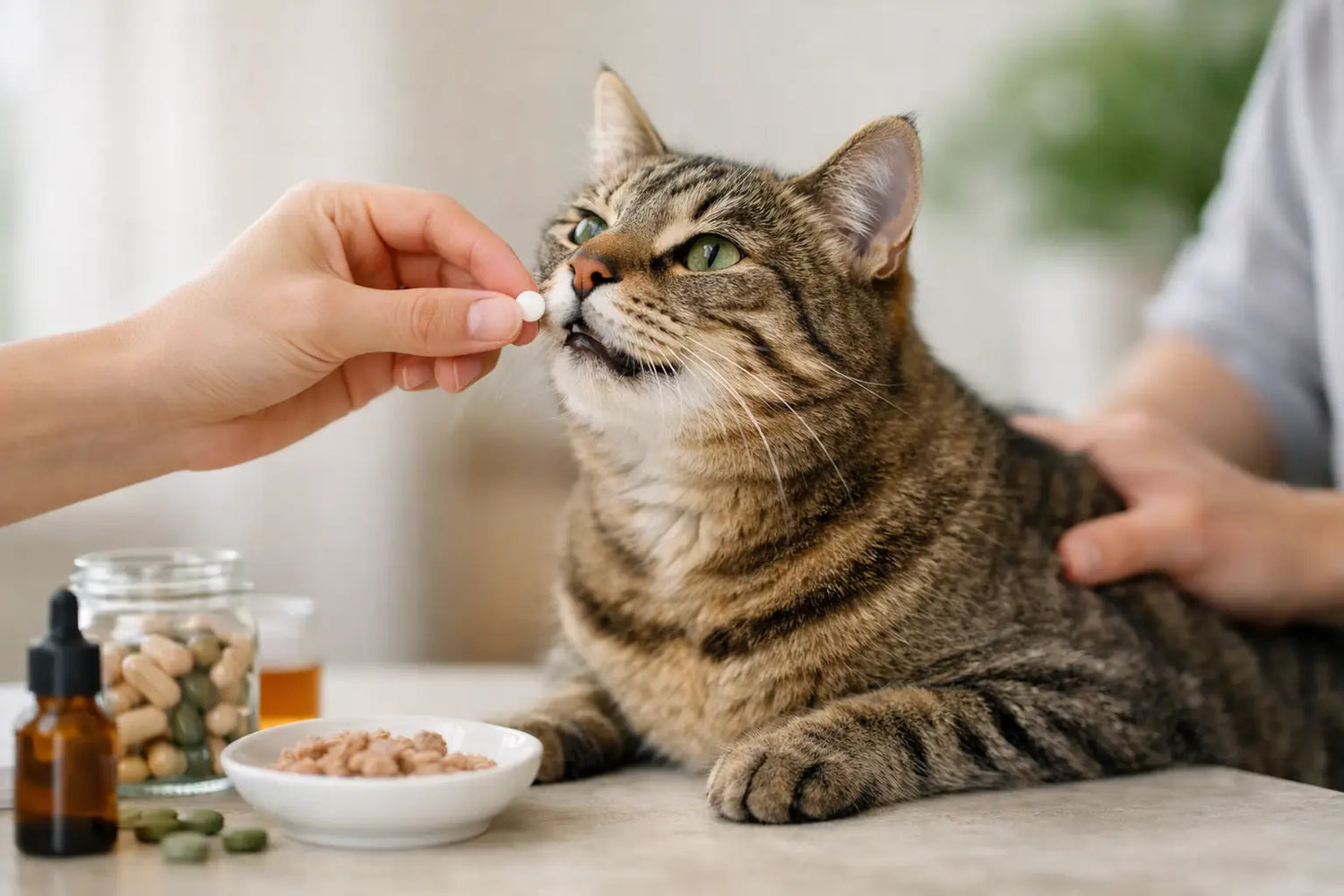
If your cat sniffs the supplement, looks at you offended, and walks away, you are in good company. Understanding how to give nutraceuticals to a cat is not just a matter of patience: the form of the product, the time of day, the taste, and especially the reason for administering it all matter.
How to Give Nutraceuticals to Your Cat the Right Way
The first point is simple: not all cats accept a nutraceutical in the same way. Some take it without problems in wet food, others reject any new smell, and others tolerate only small amounts at a time. For this reason, the best strategy is not to force it but to choose a method compatible with the cat’s character and routine.
A nutraceutical can be useful as functional support in various situations: tired liver, reduced vitality, need for joint support, localized hygiene of ears, eyes, or paw pads, irritated skin. But the expected benefit is seen only if the product is used regularly and as directed. Skipping doses, changing the method every day, or stopping too soon is one of the most common mistakes.
First Rule: Start from the Real Need
Many owners look for a natural product and then wonder how to get their cat to take it. In reality, the correct step is the opposite: first identify the problem, then choose the most suitable nutraceutical, and finally find the best way to administer it.
If the cat needs liver support, for example, it makes sense to opt for targeted formulations with functional ingredients like milk thistle standardized in silymarin, betaine, zinc, and B vitamins. Milk thistle is among the most studied phytocomplexes for supporting liver function thanks to the antioxidant action of silymarin, while betaine and vitamins participate in the body's metabolic processes. In these cases, consistency is more important than the amount taken at once.
If the problem concerns stiff joints, difficulty jumping, or less desire to move, a different support is needed. Ingredients like Perna canaliculus, Boswellia serrata, spirulina, and Aloe arborescens are chosen specifically to support joint health and counteract oxidative stress that can worsen comfort and mobility.
How to Get Your Cat to Accept the Nutraceutical
This is where the practical part comes in. Cats are very selective animals and often reject novelty more than the product itself. The most effective way is to introduce the nutraceutical gradually, in small amounts, without altering the meal’s smell too much.
For products to be taken orally, the simplest solution is to mix the dose into a very palatable and well-tolerated food, preferably wet and in a small portion. A small amount of food facilitates complete intake of the product. If you put the nutraceutical in a full bowl and the cat only eats half, you cannot be sure of the actual dose taken.
Temperature also helps. Slightly warmed food releases more aroma and can better mask the taste. However, be careful not to overheat the product or improvise: some active ingredients are sensitive to excessive treatments, and for this reason, cold processing methods are appreciated when the goal is to preserve natural functional principles.
When Not to Mix It with Food
Food is not always the right way. If the cat associates an unpleasant smell with its usual food, you risk compromising the meal and creating refusal even in the following days. This happens especially in more suspicious cats or those with delicate appetites.
In these cases, it is better to use a highly appreciated treat reserved only for administration or follow the veterinarian’s instructions for direct administration. Forcing should remain the last option: it increases stress, worsens the relationship, and often makes the cat even less cooperative next time.
Dosage, Timing, and Consistency: Routine Makes the Difference
A nutraceutical is not a one-time solution. It works better when it becomes part of a consistent routine, with timing appropriate to the animal’s needs. Some supports require days, others weeks. This does not mean they are weak, but that they work alongside the body’s physiological functions.
For this reason, it is always advisable to choose products formulated for a specific purpose. Liver support should be given at the indicated times and amounts; joint support requires continuity; dermofunctional products for skin, ears, eyes, and paw pads have different usage methods because they act locally.
When the cat takes multiple products, order is necessary. Not everything should be given together for convenience. Sometimes separating administrations improves acceptance and reduces the risk of refusal. If you have doubts, the veterinarian remains the reference, especially for older cats, those on medication, with chronic diseases, or with very selective diets.
Oral Nutraceuticals and Localized Products: They Are Not the Same Thing
A common mistake is to call “supplement” everything that supports the cat’s well-being. In reality, a distinction must be made. Oral nutraceuticals support specific internal functions, while dermofunctional and cleansing products work on external areas such as ears, eyes, skin, or paw pads.
If the cat often shakes its head, has ear odor or visible earwax, there is no need to wonder how to give an oral product if the need is local. In that case, an ear cleanser with ingredients like aloe, calendula, propolis, coconut oil, and tea tree oil is more useful, chosen for their soothing, rebalancing, and cleansing action.
The same applies to sensitive eyes or light secretions, where a solution with aloe, chamomile, cornflower, and witch hazel can help with daily cleansing. If the problem is dry or cracked paw pads, emollient and protective actives like aloe, carrot, urea, shea butter, sweet almond oil, and vitamin E make more sense. The right answer always starts from the site of the problem.
The Value of Functional Natural Ingredients
When talking about cat well-being, “natural” alone is not enough. The quality of the ingredient, its concentration, combination with other actives, and how it is processed all matter.
Aloe arborescens, for example, is appreciated for its phytocomplex profile and its soothing and antioxidant contribution. Carrot, in its various varieties, provides interesting plant components for tissue nourishment. Boswellia is known in literature for supporting physiological inflammatory processes, while spirulina is considered a natural source rich in nutrients. In liver support, silymarin from milk thistle remains one of the most recognized plant actives. It is not the single ingredient that does everything, but a well-thought-out formula.
The Most Common Mistakes When Trying to Give Nutraceuticals to Your Cat
The first mistake is changing the product too quickly. If the cat refuses the first administration, it does not automatically mean the nutraceutical is unsuitable. It may just be a matter of method.
The second mistake is ignoring the clinical context. A cat with nausea, oral pain, environmental stress, or ongoing diseases may refuse even its favorite food. In these cases, the problem is not the supplement but the underlying condition.
The third mistake is using generic products when the need is specific. If you are looking for help with joints, liver, skin, or localized hygiene, targeted formulations are needed. This is where the difference between a simple commercial product and a specialized line really shows.
For those who want a concrete solution, choosing veterinary formulations with selected functional ingredients processed to preserve their integrity offers a real advantage. Aloeplus Cani e Gatti moves precisely in this direction, with an approach that combines naturalness, specialization, and practical attention to daily administration.
When to Ask Your Veterinarian for Support
If the cat refuses the nutraceutical for several days, loses appetite, vomits, changes behavior, or shows persistent symptoms, it is time to stop and investigate further. The same applies if you are using a product as support alongside medication or diagnosed diseases.
The nutraceutical is an ally, not a substitute for clinical evaluation. It works well when included in a correct path, with realistic expectations and clear goals. This approach truly protects the animal and helps the owner see concrete results without improvisation.
If your cat is difficult, don’t immediately think “it’s impossible with him.” Often, it just takes the right product, at the right time, with the right method. And when administration stops being a daily battle, care also becomes easier to carry out.