
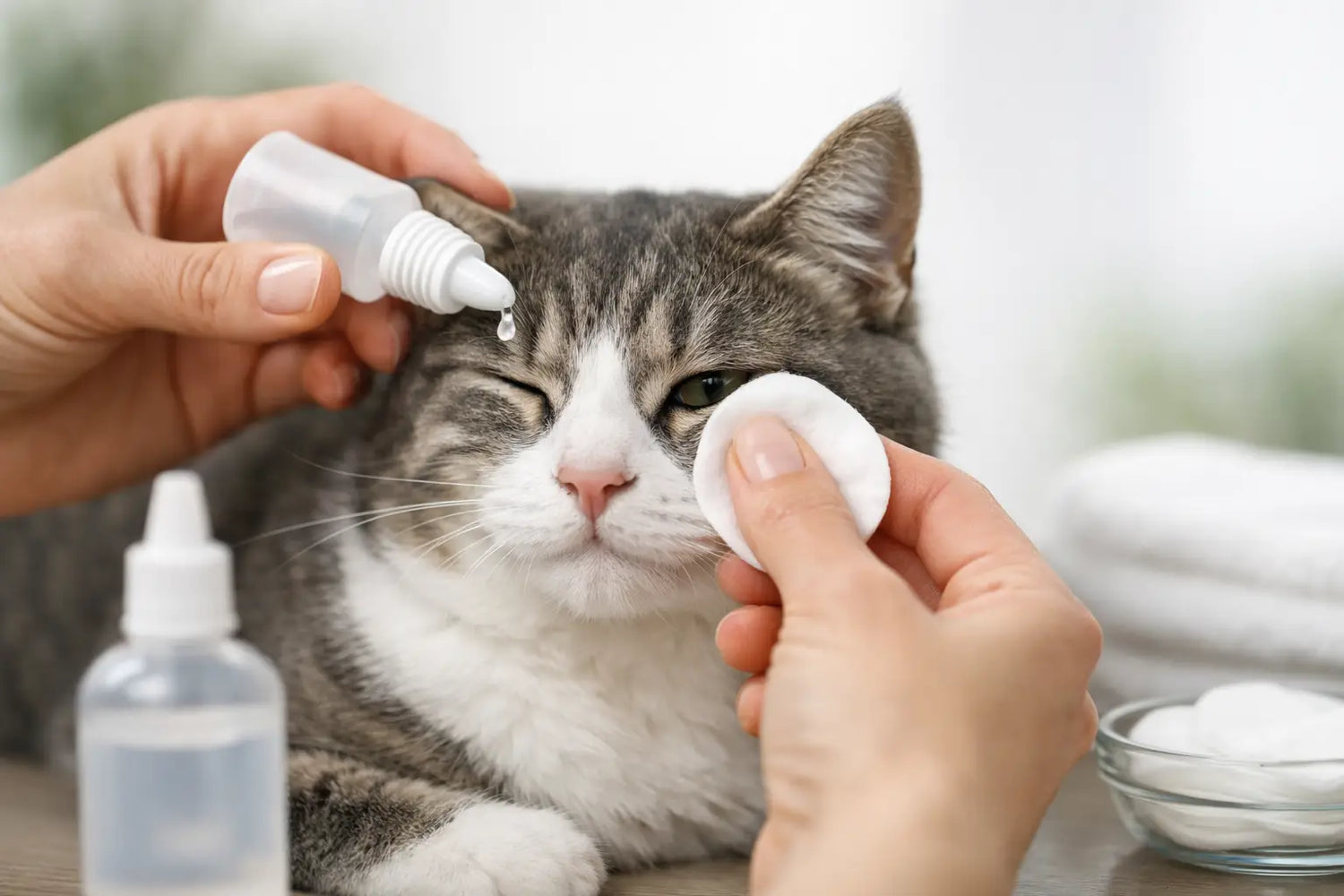
A cat’s eyes should not be cleaned “randomly,” just because there is a little tearing or a crust at the inner corner. Understanding how to choose a cat eye cleanser means first distinguishing between simple daily hygiene and a sign that deserves a veterinarian’s attention. This is where many owners make mistakes: they use products that are too harsh, formulas not designed for the delicate periocular area, or worse, improvised home remedies.
How to choose a cat eye cleanser without mistakes
The first rule is simple: a cat eye cleanser must respect the physiology of the eye and eyelid area. It should not sting, leave irritating residues, or further alter an already sensitive surface. If your cat tends to have tearing, light secretions, damp fur under the eye, or small impurities that accumulate after sleep, a gentle but effective solution is needed.
The point is not to choose “the strongest product,” but the most suitable one. In the eye area, strength is not an advantage. A formula that is too harsh can increase discomfort, cause the cat to rub its eyes, and worsen redness and sensitivity. For this reason, it is best to choose cleansers specifically designed for cleaning around the eyes, with soothing and well-tolerated ingredients.
Another crucial aspect is the intended use. If the issue is daily cleaning of a generally moist eye, the choice will be different from a cat with eyes exposed to dust, wind, pollen, or more frequent secretions. The right cleanser should help gently remove dirt and accumulated material without turning the hygiene routine into a source of stress.
When an eye cleanser is really needed
A bit of clear secretion upon waking can be normal, especially in some more predisposed cats. The same applies to brachycephalic cats, like Persians and Exotic Shorthairs, who due to their conformation may have more noticeable tearing and stains in the periocular fur. In these cases, regular cleaning helps keep the area clean and reduce residue buildup.
The situation is different with dense, yellowish, or greenish secretions, squinting, strong redness, pain, obvious itching, or photophobia. Here, a cleanser is not enough and should not be used to delay a visit. Cleaning can support care, but the cause must be identified. Allergies, conjunctivitis, foreign bodies, mechanical irritations, or eyelid abnormalities require professional evaluation.
In practice, an eye cleanser makes sense when there is a need to keep the area clean, reduce residues, and promote local comfort. It does not replace therapy but can make a big difference in the daily management of delicate eyes.
Preferred ingredients in a cat eye cleanser
When evaluating a formula, the composition matters more than generic label promises. For the eye area, natural ingredients known for their soothing, refreshing, and softening action are particularly useful.
Aloe is among the most interesting when properly included in dermofunctional formulations dedicated to pets. It is valued for its ability to provide comfort to delicate tissues and support skin well-being in easily irritated areas. In a well-formulated eye cleanser, it helps make cleaning less harsh and more respectful of the cat’s sensitivity.
Chamomile and cornflower are also traditionally associated with gentle cleansing of the periocular area. Chamomile is known for its calming properties, while cornflower is often used in products for sensitive eyes due to its refreshing effect. Witch hazel, when well dosed and included in an appropriate formulation, can help keep the outer eye area clean and toned.
This combination makes sense especially for cats with recurring tearing, mild redness from external agents, or frequent secretion buildup. There is no need to chase complicated formulas. A clean, targeted composition developed for regular use is what matters.
What to avoid when choosing
If you’re wondering how to choose a cat eye cleanser safely, the most useful part is knowing what to discard immediately. Avoid products not specifically for veterinary use or those generally intended for fur cleaning. The eye area is not just any skin area.
It’s also better to avoid heavily scented formulas, excessively foaming products, or those with potentially irritating components for mucous membranes. An eye cleanser should be essential, gentle, and clearly intended for periocular cleansing. The more the product aligns with this function, the lower the risk of unwanted reactions.
There is also a common mistake: using DIY solutions or homemade infusions. Even when made with good intentions, they do not guarantee sterility, stability, or controlled concentration. Improvising in the eye area is a bad idea.
Consistency and format make a difference
Not all cats tolerate cleaning the same way. Some accept a moistened gauze well, others get restless as soon as you approach their face. For this reason, the format also matters. A practical solution to apply on sterile gauze or a soft pad, without excess and without having to manipulate the eye too much, is often the best choice.
The right product should simplify the routine. If it requires complex steps, drips too much, or leaves the area sticky, it will be hard to use consistently. And in eye cleaning, consistency matters more than occasional gestures. A light but regular cleaning gives better results than sporadic and too vigorous interventions.
The value of a natural but thoughtfully crafted formula
In natural pet wellness, just recognizing a known ingredient is not enough to trust it. What matters is how it is processed, in what concentration it is used, and in what synergy it is included. A well-studied formulation combines naturalness and function without sacrificing safety and tolerability.
For this reason, in the presence of sensitive eyes, eye cleansers that focus on plant actives chosen for a precise goal make sense: to cleanse, soothe, and respect. A solution like Oftocur, based on aloe, chamomile, cornflower, and witch hazel, is created exactly for this type of need. It helps gently remove secretions and impurities from the cat’s eye area while providing daily support for local comfort.
The interest in ingredients like aloe and chamomile is no coincidence. Scientific literature has observed, in various dermatological and mucosal contexts, the potential of plant substances with soothing and protective activity for superficial tissues. Naturally, each product must always be considered in its complete formulation and correct use. But choosing actives with a well-established history of use is already a good criterion.
How to use the cleanser correctly
Even the best cleanser can be ineffective if applied incorrectly. Ideally, moisten a sterile gauze or soft support and gently wipe from the inner corner outward, without rubbing. If there are dry crusts, it’s best to soften them first with the product and remove them only when they come off easily.
Each eye should be cleaned with a different gauze, especially if there is obvious secretion. This simple precaution reduces the risk of transferring impurities from one side to the other. After cleaning, the area should remain dry and clean, not wet for long.
If the cat resists, do not force it roughly. It’s better to choose a calm moment, perhaps after a meal or during a relaxation phase. Eye cleaning should become a quick, predictable, and non-traumatic gesture.
When to change product or seek advice
If after a few days of correct use the area remains very red, tearing increases, or the cat keeps the eye closed, it’s not the time to insist on hygiene alone. It’s time to take a further step and clarify the cause.
The same applies if the cleanser causes obvious discomfort, increased rubbing, or worsening of the eye contour’s appearance. A good product should help daily management, not complicate it. That’s why the best choice combines gentleness, formulation consistency, and functional ingredients truly designed for the eye area.
A cat’s eyes quickly show when something is wrong. Observing them carefully, cleaning them thoughtfully, and choosing a specific formula is a small gesture only in appearance: it is often one of the most concrete ways to protect their well-being every day.