
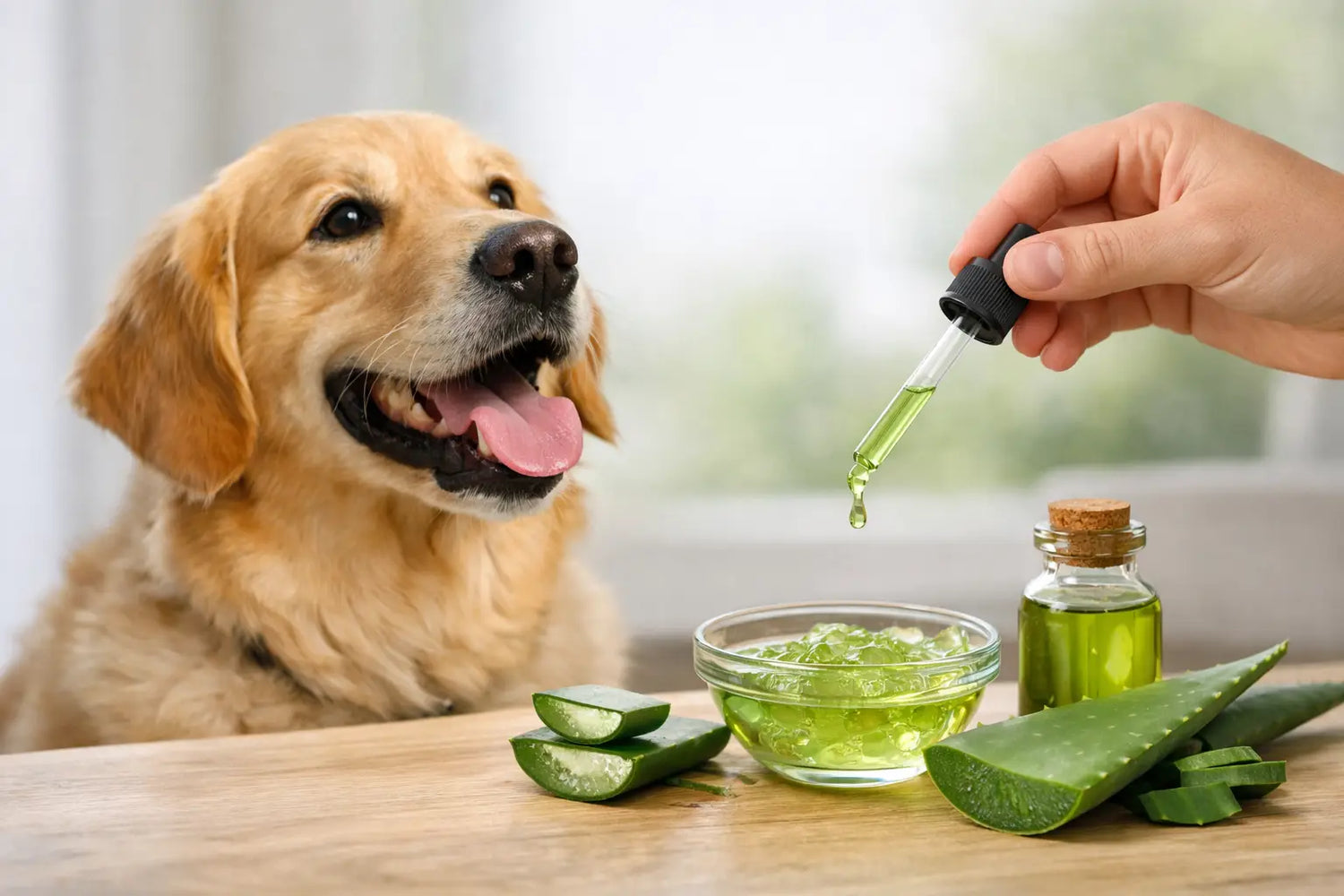
If your dog has red skin, cracked paws, small irritations, or needs gentle and natural support, it’s normal to wonder how to give aloe to your dog without making mistakes. The right answer is never to improvise. It matters which part of the plant is used, the formulation, and especially the purpose: topical use, localized hygiene, or functional support.
Aloe is an interesting resource in integrated veterinary care, but it must be managed wisely. Not all aloe is the same, not all products for human use are suitable for dogs, and DIY with fresh plants can lead to avoidable errors. That’s why it’s worth understanding when aloe can really help and how to use it practically and safely.
How to give aloe to your dog without mistakes
The first point to clarify is simple: aloe can be used on dogs topically or, in some cases, within oral formulations designed for animals. What should not be done is giving dogs generic preparations, uncontrolled juices, or parts of the plant collected at home without knowing how to distinguish the inner gel from the more irritating outer component.
In aloe leaves, in fact, there are portions with different functions. The inner gel is the best known for its soothing and moisturizing action. The outer part and the latex contain anthraquinones, such as aloin, which can be irritating to the gastrointestinal tract and are not recommended for improvised administration to dogs. This is one of the reasons why the quality of processing makes all the difference.
When the goal is the skin, the most sensible solution is to choose a veterinary dermofunctional product that is already balanced. When a broader support is sought, for example for joints or general well-being, it is preferable to opt for veterinary nutraceutical formulations where aloe is combined with other active ingredients with a precise rationale.
Topical use: when aloe is really useful
External application is the context in which aloe is used most easily. It can be a useful choice when the dog has localized redness, sensitive skin, dry areas, rough pads, discomfort after rubbing, or needs gentle cleansing in specific areas.
Here, aloe’s advantage is mainly functional. The gel helps to hydrate, soothe, and maintain skin comfort. In the literature, aloe vera and related species have been studied for their emollient, film-forming properties and possible support for the physiological skin repair processes. This does not mean it replaces a veterinary diagnosis when there is dermatitis, infection, or a deep lesion. However, it means that, in the right cases, it can be a concrete help in daily management.
To apply it well, start by cleaning the area. The skin should be gently cleansed, then the product is spread in a thin layer. It’s better to avoid excessive amounts: abundance is not needed, uniformity is. After application, it’s useful to distract the dog for a few minutes to reduce the risk of licking the treated area immediately.
For the paws, for example, a formulation with aloe and carrot enriched with emollient substances like shea butter, sweet almond oil, urea, and vitamin E has a precise purpose. Aloe helps soothe, carrot provides antioxidant compounds, while the nourishing component supports skin softness and elasticity. It’s a more complete approach compared to using pure, unstabilized aloe.
Also, for small skin irritations or areas stressed by rubbing, a gel or spray formula with aloe combined with botanical actives like calendula, propolis, or peppermint can offer a more targeted local action. The logic is always the same: not an isolated ingredient used randomly, but a functional complex designed for a real need of the dog.
Oral administration: it can be done, but not improvised
When it comes to oral use, the question becomes more delicate. Can you give aloe to a dog by mouth? In theory yes, but only if it is a product formulated for veterinary use, with controlled raw materials and processed to preserve useful components while reducing unwanted ones.
The problem with DIY is that many owners associate aloe with a universal remedy. It is not. Aloe juice purchased for human use may contain ingredients not ideal for dogs, sweeteners, flavors, preservatives, or an inappropriate concentration. Even worse is using fresh leaves without proper preparation.
In modern veterinary formulations, aloe is often included as part of a broader functional support. Think of products for joint well-being, where Aloe Arborescens can work together with Perna canaliculus, spirulina, boswellia serrata, and devil’s claw. Here we are not talking about “giving aloe” in a generic sense, but offering the dog a reasoned supplementation, useful for mature, athletic, or stiff-jointed subjects.
The same principle applies when aloe is present in products dedicated to specific areas of well-being. The strength is not only in the ingredient but in the synergy and processing method. A well-designed cold process helps preserve the most sensitive active principles, a decisive aspect when aiming for naturalness without sacrificing practical effectiveness.
How to give aloe to your dog in practice
If the product is topical, administration is simple: apply it to the affected area according to the instructions on the label or as suggested by the veterinarian. The most common areas are skin, paw pads, outer ear flap, and eye contour, but here you need to distinguish very well. Ears and eyes require dedicated products, not generic gels.
For ear hygiene, for example, aloe can be useful if combined with calendula, propolis, coconut oil, and tea tree oil in a cleansing solution formulated for dogs. In this case, it’s not about “putting aloe in the ear,” but using a specific cleanser that helps clean and maintain the balance of the external canal. The same applies to the eye area, where aloe should only be included in cleansers designed for that delicacy, together with extracts like chamomile, cornflower, and witch hazel.
If the product is oral, the rule is even more concrete: follow the dose indicated by the manufacturer or veterinarian based on the dog’s weight. Some dogs accept direct administration well, others tolerate it better if the product is mixed with a small amount of favored food. It’s better not to change doses to speed up results. With nutraceuticals, consistency matters more than excess.
When to avoid aloe or consult the veterinarian first
There are situations where professional evaluation is needed before using any product, even natural ones. If the dog has vomiting, diarrhea, chronic diseases, ongoing therapies, extensive lesions, deep wounds, suspected otitis, abnormal eye secretions, or severe persistent itching, aloe should not become a way to postpone the visit.
Dogs that are very allergic or have extremely reactive skin also deserve caution. Natural does not automatically mean harmless for every subject. Testing on a small area when using a new topical is a good habit. If marked redness, discomfort, or persistent licking appears, it’s better to stop and consult the veterinarian.
For oral use, caution is even greater in puppies, pregnant or nursing females, and dogs with sensitive intestines. The point is not to create alarm but to make the right choice: use only formulas designed for pets and with a clear intended use.
Why veterinary formulation changes the outcome
Anyone who lives with a dog knows well: the difference between a product that stays in the drawer and one that really becomes part of the routine lies in visible effectiveness and ease of use. Aloe alone may seem like a natural shortcut, but the best result comes when it is included in specialized formulas, designed for a precise function and developed with appropriate standards.
A base of Aloe Arborescens processed cold, for example, better preserves sensitive compounds and becomes more interesting when combined with other functional ingredients. Carrot supports with its antioxidant profile, calendula helps skin comfort, propolis is appreciated in formulas for localized hygiene, boswellia and devil’s claw find their place in joint needs. It is this technical approach that transforms a generic remedy into a concrete solution.
For those seeking a natural but serious approach, the safest path is exactly this: not just asking if aloe is good, but which aloe, in what form, and for which dog problem. It is the most responsible way to achieve real benefits without improvising.
When a natural ingredient is supported by veterinary formulation, careful processing, and clear practical instructions, it truly becomes part of the dog’s daily care with a useful, simple, and reassuring role.