
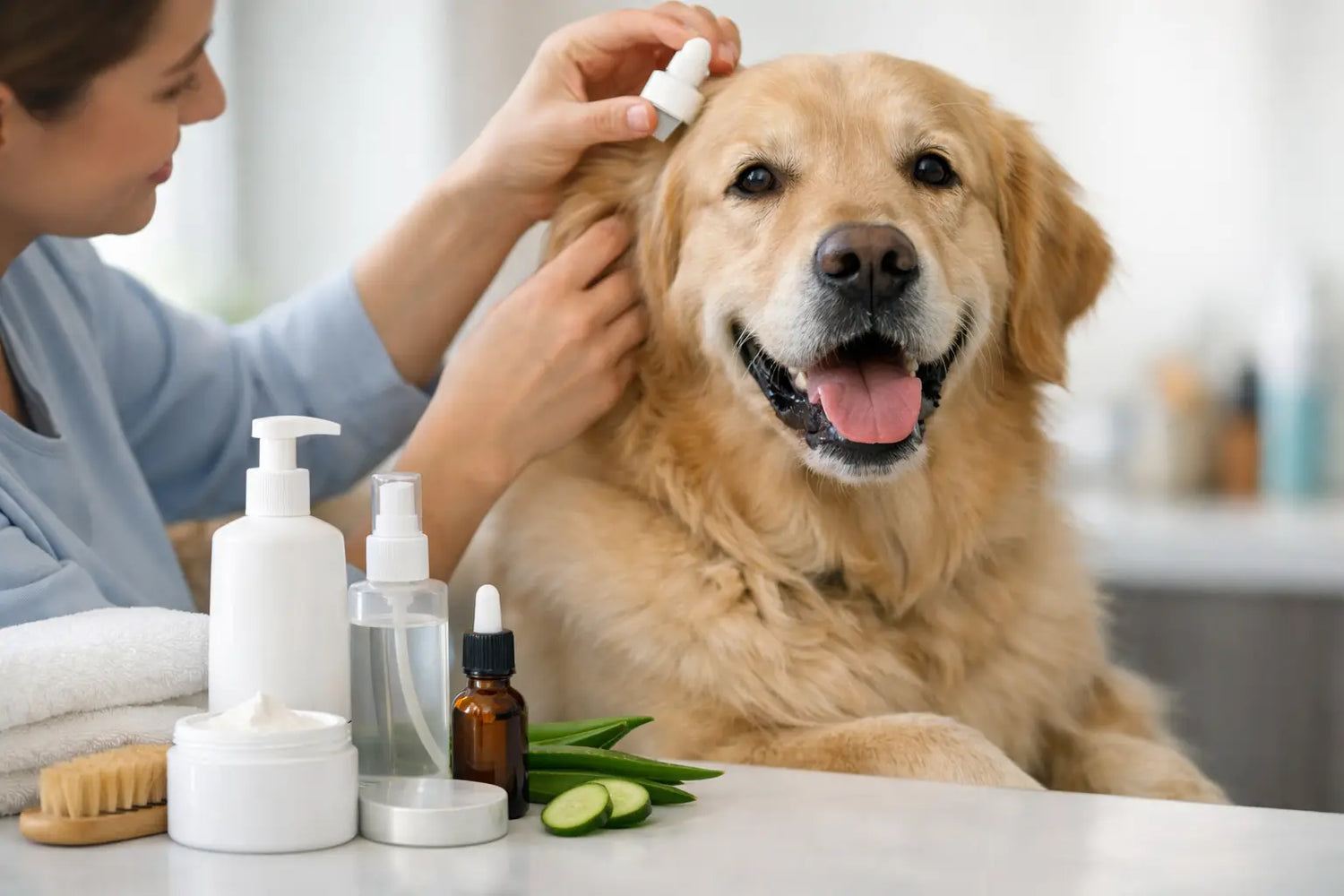
When a dog constantly licks its paws, shakes its head, has red skin, or shows localized bad odor, the problem is not just cosmetic. In many cases, targeted support is needed, and this is where dermofunctional products for dogs come into play: formulations designed to cleanse, protect, and maintain the balance of the skin and its appendages, respecting the animal’s physiology.
The difference compared to a generic product lies entirely in the function. A dermofunctional product is not created to cover a symptom with fragrance or harsh cleansing, but to act locally on specific needs such as redness, skin sensitivity, dryness, ear hygiene, eye contour cleaning, or protection of the paw pads. For those who consider their dog a family member, this distinction matters a lot.
What dermofunctional products for dogs really are
The term may sound technical, but the concept is simple. Dermofunctional products for dogs are topical solutions designed to support the well-being of the skin and areas most exposed to daily stress. They do not replace the veterinarian when there is a pathology to diagnose, but represent concrete support in daily management and prevention of worsening conditions.
A dog’s skin is more delicate than often believed. It has a precise balance influenced by humidity, temperature, friction, environmental allergens, too frequent washing, or unsuitable formulations. It takes little to disrupt this balance: a walk on hot surfaces, moisture trapped in the ears, eye secretions that irritate the eye contour, or the tendency to continuously lick an already sensitive area.
For this reason, the choice of product must start from the real problem. Gently cleansing is one thing; soothing, moisturizing, protecting, or sanitizing a specific area with selected functional actives is another.
When they are really needed
There are signs that deserve immediate attention. Cracked paws, dry skin, localized redness, unpleasant ear odor, tearing that soils and irritates the periocular fur, skin discomfort after walks or grooming. In these situations, early intervention with targeted formulas helps break the irritation-licking-friction cycle.
Of course, not everything can be solved with a topical product. If the dog has pain, extensive lesions, abnormal secretions, or persistent itching, veterinary evaluation remains the first step. The point is different: between neglecting the problem and medicalizing every small sign, there is a space for daily care made of correct actions and well-formulated products.
The natural ingredients that make a difference
In veterinary dermofunctionality, the quality of ingredients is decisive. It is not enough for a product to be “natural” to be useful. A coherent combination of actives with soothing, emollient, moisturizing, sanitizing, or protective functions is needed, in concentrations and cosmetic bases suitable for dog skin.
Aloe Arborescens is one of the most interesting ingredients in this field. It is appreciated for its soothing, film-forming, and moisturizing action, useful on stressed or sensitive skin areas. In literature, aloe has been studied for its potential to support skin repair and modulate local inflammatory processes, although results depend on the quality of the extract and the final formulation.
Calendula also finds a place in dermofunctional applications for its softening and calming action. Chamomile and cornflower are often used in formulas dedicated to the eye contour for their gentleness. Witch hazel can help provide relief and freshness in areas prone to irritation. For paws, ingredients like urea, shea butter, sweet almond oil, and vitamin E are useful when the priority is to soften, nourish, and protect the skin barrier.
There are also actives with a stronger sanitizing function, such as propolis and tea tree oil. Here balance is needed. These are interesting ingredients but must be included in specific veterinary-use formulations, with correct dosages and carriers. DIY, especially on ears and sensitive skin, is a bad idea.
How to choose dermofunctional products for dogs without mistakes
The right question is not “which is the best overall?”, but “which is the most suitable for my dog’s need?”. A sporty dog running on asphalt and rough terrain will have different needs compared to a dog with skin folds, or a subject sensitive to ear irritations.
For paws, a formula that combines hydration and protection without leaving annoying residues is needed. A composition with aloe, carrot, urea, shea butter, sweet almond oil, and vitamin E makes sense when the pads are dry, thickened, or stressed by heat and cold. Carrot, for its antioxidant compounds, adds useful support in skin defense.
If the problem concerns a reddened or stressed skin area, a gel based on aloe and carrot, with a refreshing note like peppermint, can help provide immediate relief. However, individual tolerance matters a lot here: on very reactive skin it is always best to start carefully and observe the response.
For ears, the priority is effective but non-aggressive cleansing. A formula with aloe, calendula, propolis, coconut oil, and tea tree oil responds well to the need to clean and maintain the ear environment in good condition, especially in dogs prone to wax buildup or bad odor. However, if there is pain, dark secretions, or strong discomfort, domestic cleaning should not be insisted on: a veterinarian is needed.
For eyes, the periocular margin requires even more delicacy. Aloe, chamomile, cornflower, and witch hazel are consistent ingredients in a solution intended for daily eye cleansing, especially in dogs with frequent tearing or fur prone to staining. In these cases, consistency is more valuable than occasional intervention.
Formulation and processing method matter more than marketing
Two products with similar ingredients can give very different results. The reason is simple: the quality of the raw material matters, but so does how it is processed. Some plant actives are sensitive to heat and aggressive industrial processes. When processing is designed to preserve functional principles, the formula better maintains its effectiveness.
For this reason, production research focused on the stability of natural actives and their availability in the final formula is valuable. In the case of Aloeplus Dogs and Cats, the presence of a patented formula based on Aloe Arborescens and carrot, together with a proprietary cold processing method HDR, goes exactly in this direction: protecting the functional heritage of raw materials and transforming it into a practical, daily, easy-to-use solution.
This is not a technical detail for specialists. It is what distinguishes a product built with veterinary logic from a generic response that promises much and helps little.
From skin to localized areas: the solution changes
One of the most common mistakes is using the same product everywhere. But skin, ears, eyes, and paws have very different needs. Ears need targeted cleaning that does not alter the local balance. Eyes require maximum delicacy. Paws ask for protection and nourishment. Irritated skin often benefits from light textures, easily spreadable and non-occlusive.
This is the most effective logic: identify the problem, choose the most coherent actives, and use the product regularly. Continuity, in dermofunctionals, often makes more difference than the amount applied once.
Natural does not mean superficial
Those who choose a natural approach for their dog are not looking for a gentle but ineffective shortcut. They are looking for a well-tolerated, thoughtful, and sustainable solution over time. And this is exactly where a good dermofunctional product finds its place: accompanying daily management with functional ingredients, supported by veterinary practice and serious formulation.
Research on plant extracts in dermatology and topical use continues to grow, but it must be read with balance. Not all studies are automatically transferable to dogs, and not all actives work the same way in every situation. For this reason, it is useful to rely on products developed for veterinary use, designed for concrete problems and not to chase trends.
When a dog shows skin discomfort, the message is often simple: it needs more precise care. Choosing dermofunctional products for dogs well means listening to that signal, intervening promptly, and offering the skin the support it deserves, every day, with genuine care.