
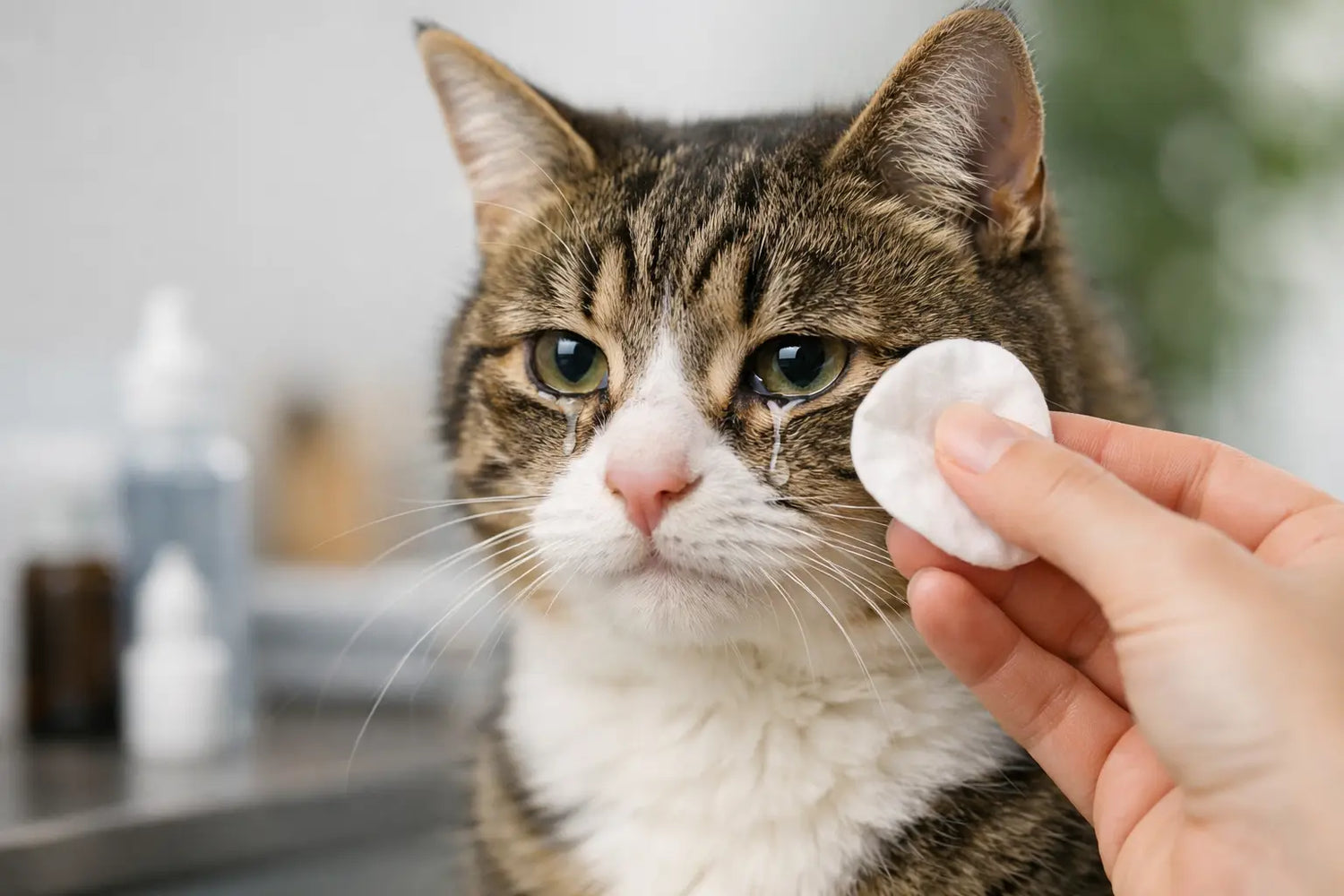
When you find wet eyelids, fur stained under the eye, and your kitty squinting, the question immediately arises: why does my cat have watery eyes? It’s not just an aesthetic annoyance. Tearing can be a mild and temporary signal, but also the first warning of irritation that needs to be managed carefully and promptly.
Cat with watery eyes: where the problem comes from
The cat’s eye is a very sensitive structure. Tears serve to lubricate, protect, and keep the eye surface clean. However, when they become abundant, continuous, or are accompanied by redness and discharge, it means something is irritating the eye or blocking normal drainage.
The causes can vary. Sometimes it’s dust, wind, harsh household cleaners, or small foreign bodies. In other cases, conjunctivitis, allergies, eyelid inflammations, minor trauma, or an anatomical predisposition come into play, especially common in brachycephalic cats, which have a flatter face and more delicate tear ducts.
There is also an aspect many owners underestimate: the periocular area, if it stays wet for many hours, tends to become irritated. The fur gets dirty, the skin reddens, and discomfort increases. That’s why it’s not enough to wait for it to pass on its own. Proper eye hygiene can make a real difference, both in the initial phase and as ongoing support for more sensitive cats.
How to tell if it’s occasional tearing or something more
An isolated episode without other symptoms can happen. But if the problem repeats or worsens, it’s worth observing some details. The clarity of the tear is already a first clue. Clear tearing may be linked to irritation or environmental sensitivity. If thick, yellowish, or greenish discharge appears, the likelihood of a more marked inflammation increases.
The cat’s behavior also speaks clearly. If it frequently rubs its face, keeps one eye half-closed, avoids light, or seems bothered when you touch the area, the eye is experiencing real discomfort. The same applies if you notice swollen eyelids, conjunctival redness, or a persistent brownish stain under the eye.
Extra care is needed for kittens and elderly cats. The former are more vulnerable to eye infections, the latter may have more fragile tissues or reduced local defense capacity. In both cases, early intervention is the safest choice.
When to see the vet without delay
There are situations where veterinary evaluation should not be postponed. If the eye appears very red, if the cat can barely open it, if the discharge is abundant and opaque, or if you notice obvious pain, it’s not the time to rely only on supportive remedies.
The same applies after trauma, a fight, contact with irritating substances, or if the cat shows general symptoms like lethargy, frequent sneezing, or loss of appetite. Some eye conditions progress quickly and require precise diagnosis. Natural hygiene remains valuable but must accompany the right treatment path, not replace it when the situation is complex.
What to do at home if your cat has watery eyes
The first rule is simple: clean without irritating. Never use cotton that leaves fibers, never rub hard, and never apply products not intended for eye use. The cat’s eye does not tolerate improvisation.
For daily cleansing, a gentle solution designed for the periocular area is needed, capable of removing discharge, dirt, and residues without disturbing the area’s balance. Cleaning should be done with soft gauze, with a light motion from the inside outward, using a clean part for each wipe. If both eyes are involved, it’s better to avoid using the same gauze on both.
This is where quality natural remedies come into play. A well-formulated eye hygiene product can help soothe, cleanse, and protect a very sensitive area. However, not all solutions are the same. The choice of active ingredients, their purity, and the method of processing matter.
The value of natural ingredients in eye cleansing
When we talk about eye wellness in cats, naturalness only makes sense if combined with precise formulation and safety of use. Aloe Arborescens is a particularly interesting ingredient in this context for its soothing, hydrating, and rebalancing properties. It helps relieve stressed skin around the eye and contributes to keeping the area more comfortable, especially when tearing tends to recur.
Alongside aloe, carrot offers useful support thanks to its components naturally rich in protective and antioxidant substances. In a dermofunctional formulation intended for localized hygiene, this type of active ingredient can help support the health of tissues exposed to frequent irritation.
The production process also makes a difference. A cold processing method like HDR is designed to best preserve natural active principles, avoiding depletion of the raw material. For those seeking a concrete solution and not just a generic promise, this is an element to seriously consider.
Cat with watery eyes: why daily hygiene really helps
Many owners intervene only when they see the eye very dirty. In reality, consistency is often more effective than occasional intervention. In predisposed cats, regular cleansing reduces secretion buildup, limits moisture retention on the fur, and helps keep local irritation under control.
This is especially useful for short-faced cats, cats living in dusty environments, or those who have already shown recurring tearing episodes. It doesn’t mean medicalizing a mild problem, but taking care of a fragility with a simple and correct gesture.
A good natural eye cleanser must be easy to use, well tolerated, and suitable even for frequent use. If the product stings, leaves residues, or makes cleaning stressful, it will be hard to maintain consistency. When the formulation is well designed, the routine becomes sustainable even for the most wary cat.
The right solution is not just cleaning, but protecting
If your goal is to truly improve the situation, it’s not enough to remove visible tears. You need to help the eye area stay clean, soothed, and less exposed to the effects of continuous moisture. This is where a specific dermofunctional solution can offer a real advantage.
A formula based on Aloe Arborescens and carrot, developed for cat eye cleansing, combines gentleness and function. Proper cleansing means removing what irritates. Soothing means reducing local discomfort. Protecting means supporting the skin and periocular fur, which are often the first to suffer from persistent tearing.
For those seeking a natural but serious approach, the point is not to use just any remedy. The point is to choose a solution made for the pet’s eye, supported by veterinary expertise, targeted formulation, and attention to the quality of active ingredients. In this sense, Aloeplus Dogs and Cats products respond well to the needs of those who want concrete, gentle support consistent with a vision of daily wellness.
The most common mistakes to avoid
Some use non-specific wipes, some try home remedies, some wait too long, and some clean vigorously thinking it will help. These are common mistakes, but the eye does not forgive rough treatments.
Stopping cleaning as soon as the eye seems better can also be counterproductive in cats prone to relapses. It’s better to think in terms of maintenance, especially if the vet has ruled out serious diseases but confirmed a tendency to tearing. Daily management, in these cases, is part of the solution.
Every cat has different sensitivity. Some improve quickly with simple consistent cleansing, others need clinical monitoring and more structured support. Knowing how to distinguish these situations is the smartest way to truly protect their eyes.
Taking care of a cat with watery eyes means observing carefully, acting gently, and choosing suitable tools. A clean and soothed eye is not only more pleasant to see: it is a sign of comfort, protection, and genuine attention toward a family member who trusts you every day.