
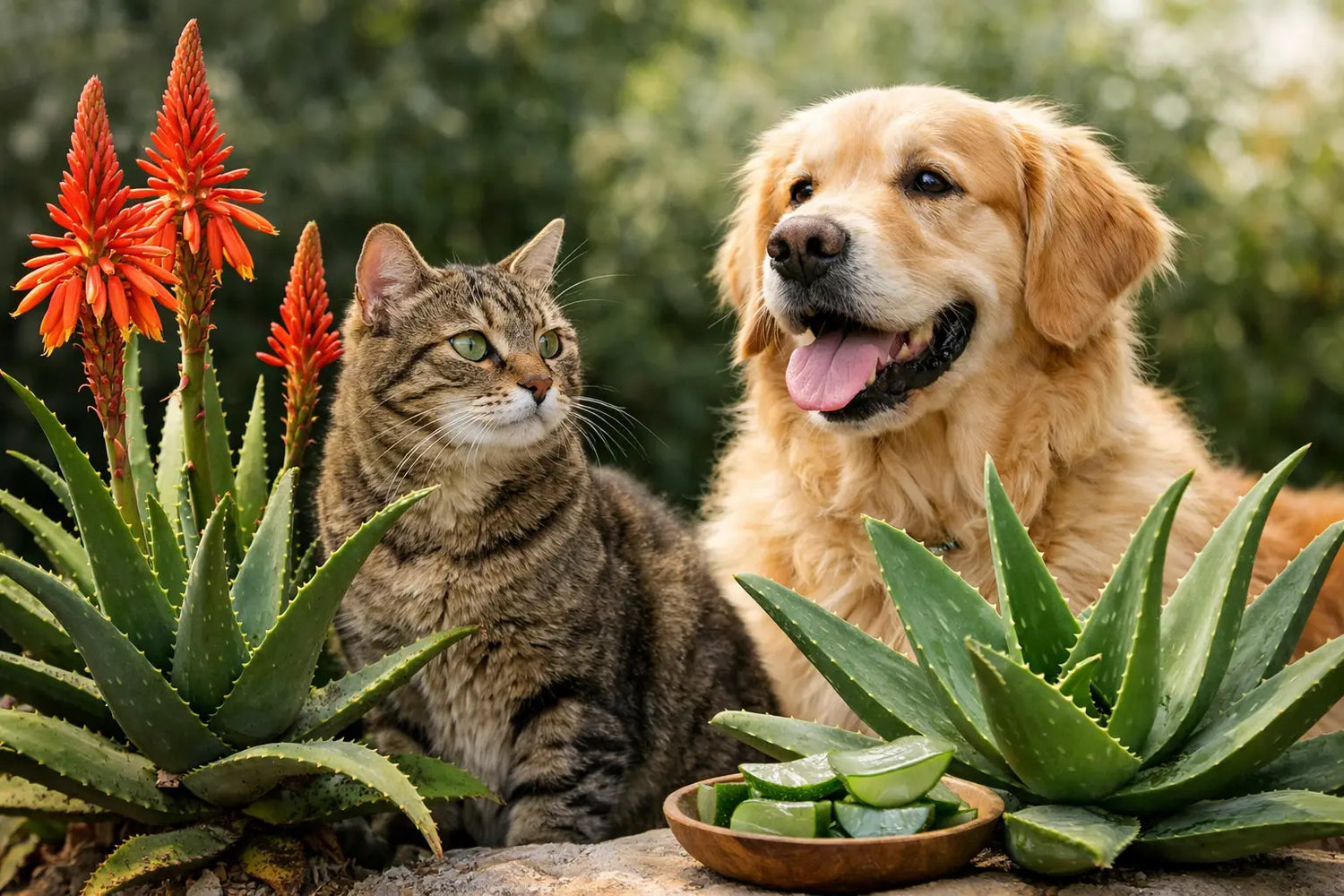
When your dog scratches often, your cat has red skin, or there is a bad odor, dirty ears, and cracked paw pads, the question is not theoretical: aloe arborescens or aloe vera, which one should you really choose? For those looking for a natural but serious help, the difference matters because not all aloes have the same composition or the same value in a product designed for the daily well-being of dogs and cats.
Aloe arborescens or aloe vera: the real difference
In common language, people simply say "aloe" as if it were just one. In reality, there are different species, and the two most mentioned are Aloe vera and Aloe arborescens. They belong to the same botanical family but are not interchangeable.
Aloe vera is the most well-known to the general public. It has been used for years in cosmetics and various skin care products thanks to the presence of mucopolysaccharides, water, vitamins, and soothing compounds. It is an interesting plant, especially when the goal is to hydrate and relieve stressed skin.
Aloe arborescens, however, is often considered richer in active ingredients relative to the amount of gel available. Its leaves are thinner and less watery, but for this reason, they concentrate a significant amount of functional components. In practical formulation, this aspect is very important when aiming for a more intense action in products intended for localized issues or targeted daily support.
This does not mean that one is always "better" than the other absolutely. It means it depends on the result you want to achieve and how the raw material is processed. For a pet with sensitive skin, recurring redness, or easily irritated areas, the quality of the aloe and the extraction method make a real difference.
Why the choice of aloe matters for dogs and cats
The skin of dogs and cats is delicate and reacts quickly to external and internal factors. Environmental allergens, excessive licking, humidity, rubbing, minor irritations, overly aggressive cleansers, or individual predispositions can disrupt skin balance. When this happens, the owner sees the signs even before a diagnosis: itching, redness, bad odor, dull coat, crusts, discomfort to the touch.
In these cases, a natural ingredient should not be chosen just because it is "trendy." It must have a specific function. Aloe is useful when a soothing, hydrating, and rebalancing action is needed. But if the product is formulated with complementary ingredients, the result becomes more interesting.
This is where a formula built around Aloe Arborescens and carrot makes sense. Carrot, thanks to its carotenoid and antioxidant content, supports skin health and helps protect tissues from oxidative stress. The combination of aloe and carrot is not an aesthetic choice: it is a formulation strategy aimed at nourishing, calming, and supporting skin physiology.
What the literature says about aloe and skin
Scientific literature on aloe, despite differences between species, preparations, and study models, shows interesting data on its soothing, hydrating properties and support for skin repair processes. Several studies have described the biological activity of polysaccharides, phenolic compounds, and other bioactive molecules present in aloe, with effects related to modulating local inflammation and maintaining skin barrier integrity.
However, it must be clearly stated that just seeing "aloe" on a label is not enough to expect the same result from every product. The botanical species, the part of the plant used, the freshness of the raw material, and especially the processing matter. Poorly treated aloe can lose part of its functional value. For this reason, when evaluating a product for dogs and cats, the production technology deserves as much attention as the main ingredient.
Aloe arborescens or aloe vera for the most common pet problems
If the main problem is dry skin or occasional sensitivity, both can theoretically make sense. But when the dog or cat has recurring discomfort and very reactive areas, more concentrated formulas designed for a synergistic action are preferred.
Think about the ears. An ear cleanser with aloe, calendula, propolis, coconut oil, and tea tree oil does more than just clean. It helps soften secretions, soothe the skin, and create an environment less favorable to dirt buildup and bad odor. In a dog with sensitive ears or a cat prone to earwax buildup, the difference is noticeable with consistent use: less discomfort, better tolerance, and improved daily management.
The same applies to the eye area. When there are secretions, redness from environmental irritation, or a need for gentle cleaning, a solution with aloe, chamomile, cornflower, and witch hazel combines cleansing and relief. Here, the point is not to attack the problem but to respect a very sensitive area.
On the paws, dryness, microcracks, contact with rough surfaces, or extreme temperatures come into play. In these situations, aloe, carrot, urea, shea butter, sweet almond oil, and vitamin E work well together because they combine hydration, elasticity, and protection of the skin tissue. A cracked paw pad is not just an aesthetic detail: it can become a source of pain and continuous licking.
The decisive point is the formulation, not the plant name
Those searching online often stop at the initial question: aloe arborescens or aloe vera. This is understandable, but it is only the first level. The real useful question is another: how was that aloe formulated for the specific need of my animal?
A generic gel can provide a temporary feeling of freshness. A veterinary dermofunctional product, on the other hand, is designed to address a real need with ingredients chosen to work together. Aloe, calendula, propolis, chamomile, carrot, tea tree oil, shea butter, or peppermint have different roles. The quality of the result depends on the coherence of the formula.
The processing method also weighs heavily. Cold processing helps better preserve the most heat-sensitive active ingredients. When a natural raw material is carefully treated, the final product maintains a richer and more stable functional profile. For this reason, a patented formula with Aloe Arborescens and carrot, cold-processed with the proprietary HDR method, represents a more advanced approach compared to standardized and less specialized solutions.
When it can be useful to choose specific products
If your goal is just to clean, you might think one product is as good as another. But in the reality of sensitive dogs and cats, this is not the case. Cleaning is one thing. Cleaning without stressing the skin while supporting its well-being is another.
For a dog with localized itching and easily irritated skin, a gel formulation with aloe and carrot can be a practical choice because it adheres well to the area and helps maintain skin comfort. For larger or hard-to-reach areas, a spray with aloe, calendula, propolis, and tea tree oil makes application easier and more uniform. If the discomfort affects the ears or eyes, dedicated products with ingredients calibrated for that specific area are needed.
This approach is also more serious from a safety perspective. Dogs and cats are not small humans, and their skin should not be treated with improvised solutions. Formulating for pets means considering tolerance, ease of use, and frequency of application.
The most useful answer for those who live every day alongside their animal
So, aloe arborescens or aloe vera? If we talk about daily veterinary well-being, delicate skin, dermofunctional support, and formulas truly designed for dogs and cats, Aloe Arborescens offers very interesting characteristics, especially when included in a synergistic composition and processed with a conservative method.
It is not a popularity contest between plants. It is a functional choice. The owner who wants concrete results must look at the botanical species, yes, but also at the presence of other natural actives, veterinary specialization, and the quality of the production process. This is what transforms a well-known ingredient into a useful solution.
At Aloeplus Dogs and Cats, this logic guides every formulation: starting from a real pet need, selecting natural ingredients with a precise function, and building a practical, credible, and results-oriented response.
When your animal shows skin discomfort, there is no need to chase the most famous remedy. You need to choose the most suitable one, with the peace of mind of offering daily care that is respectful, targeted, and truly designed for its well-being.