
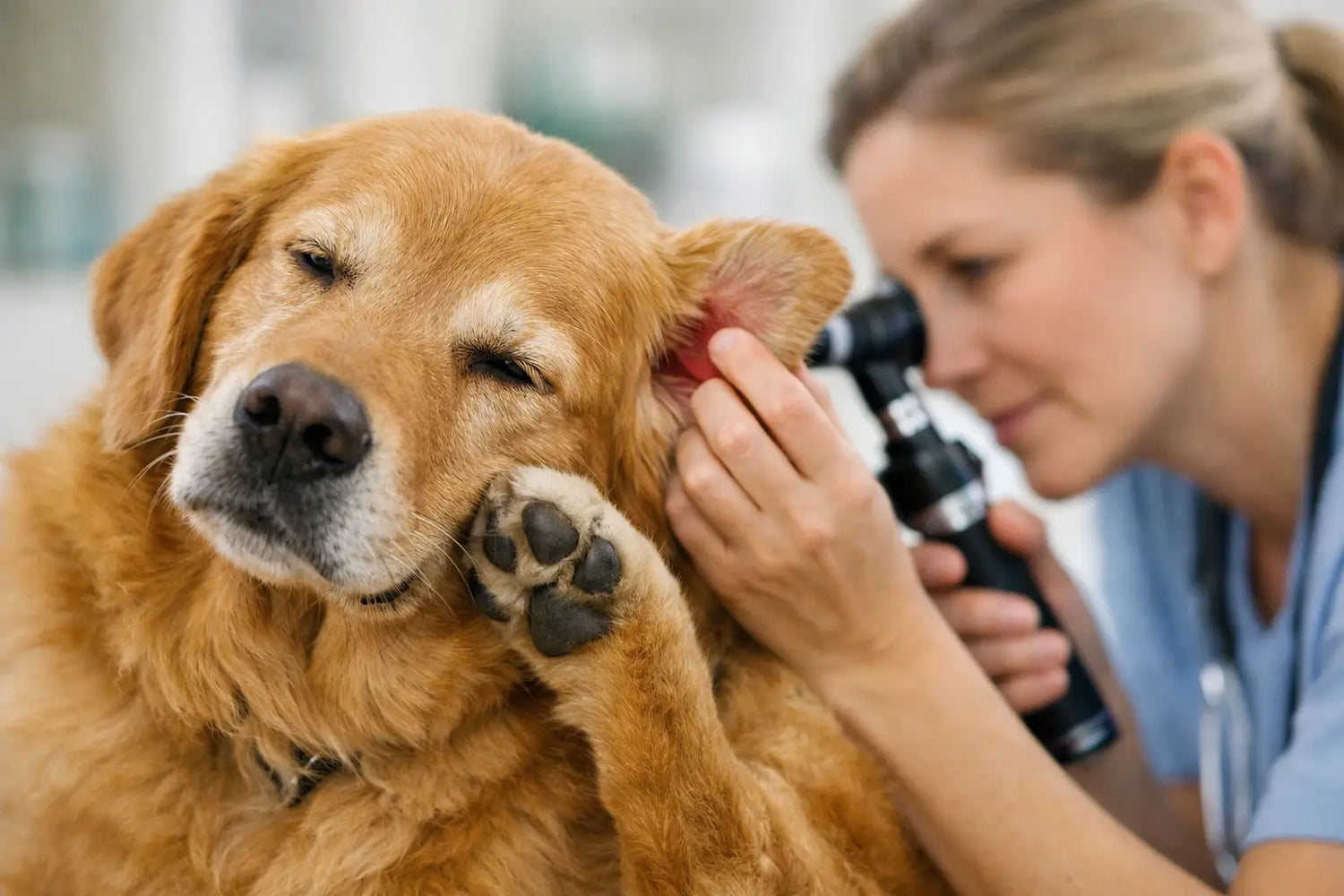
If your dog often shakes its head, persistently scratches an ear, or suddenly avoids being touched, pause for a moment: among the 5 signs of ear infection in dogs are very clear symptoms that often appear even before obvious pain. Recognizing them early makes a difference because a neglected ear infection can quickly worsen, become very uncomfortable, and require longer recovery times.
Why ear infections are so common in dogs
A dog’s ear has a particular structure, with a long and angled ear canal that can more easily retain moisture, earwax, and debris. This creates a favorable environment for the growth of yeasts, bacteria, and, in some cases, parasites like mites. Some breeds with floppy or very hairy ears are more predisposed, but the problem can affect any dog.
There is also an often underestimated aspect: ear infections don’t always develop on their own. Sometimes they are the result of allergies, dermatitis, excess moisture after bathing, foreign bodies like grass awns, or inadequate cleaning. For this reason, simply observing the symptom without understanding the context is not enough. Daily attention is needed and, when necessary, the support of a veterinarian.
The 5 signs of ear infection in dogs
1. The dog shakes its head often
This is one of the most typical warning signs. If the dog repeatedly shakes its head, especially after waking up, after a walk, or without an apparent cause, there may be discomfort in the ear canal. Intense pain is not always present at the beginning. Often there is a sensation of itching, pressure, or irritation that the animal tries to relieve this way.
If the behavior lasts more than a day or two or becomes persistent, it’s best not to wait. Continuous shaking can worsen the inflammation and, in more serious cases, also cause scratching injuries or small ear traumas.
2. Scratching the ear or rubbing the head
Among the 5 signs of ear infection in dogs, localized itching is one of the easiest to notice. The dog may scratch with its paw, rub its face on the floor, sofa, or against furniture. Sometimes it seems like an occasional gesture, but frequency is the key detail.
Ear itching can appear in the early stages of external ear infection, when the canal is already irritated but not yet severely compromised. If, in addition to scratching, you notice nervousness or irritability when touching the area, suspicion increases. At this stage, proper ear cleaning can help reduce buildup and impurities, but if the discomfort persists, a veterinary evaluation is essential to understand the exact cause.
3. Bad odor from the ears
A healthy ear should not have a strong smell. If you notice a sharp, unpleasant, or unusual odor when you get close, it is very likely that there is an imbalance locally. Bad odor is often associated with microbial or fungal overgrowth and should not be considered a minor detail.
This sign is particularly useful because it can appear even before very obvious discharge. In many cases, owners notice it while petting the dog or during normal hygiene. This is an important point: checking the smell of the ears is not a trivial act but part of prevention.
From a daily care perspective, cleaning the ear with gentle and effective formulas can be very helpful to keep the ear environment clean and less prone to irritation. Ingredients like aloe, calendula, and propolis are appreciated for their soothing, softening, and rebalancing action, especially in phases when there is local sensitivity but self-treatment should be avoided.
4. Redness, dark earwax, or discharge
When you gently lift the ear flap, the inside should appear clean, with a uniform pink color. If you notice marked redness, very abundant earwax, brownish, yellowish material, or moist discharge, the suspicion of ear infection becomes concrete.
Not all discharges are the same. Dark, dry earwax may suggest some infestations or a chronic alteration, while a wetter, foul-smelling exudate may appear in bacterial or mixed forms. This is one of those cases where self-treatment risks confusing the picture. Over-cleaning, using unsuitable products, or inserting cotton swabs into the canal can worsen the situation.
Veterinary literature confirms that external ear infections in dogs are often multifactorial and that effective management involves evaluating the ear content, inflammation, and predisposing causes. In practice, seeing discharge means the ear already needs more precise attention.
5. Pain, sensitivity, and behavioral changes
The last of the 5 signs of ear infection in dogs is often the most worrying because the discomfort becomes obvious. The dog may complain if you touch its head, pull back, hold the ear down, appear less lively, or even refuse contact. Some dogs eat with less enthusiasm because jaw movement increases discomfort in the ear area.
When pain appears, inflammation may already be advanced. And here is an important point: not all ear infections have the same severity. Some remain localized and resolve well if treated early, others tend to recur because there is an underlying allergic or dermatological basis. For this reason, observing the dog’s overall behavior is as useful as looking at the ear.
What to do when you notice these symptoms
The first rule is simple: don’t wait for it to go away on its own. If you notice one or more of these signs, gently check the ear without manipulating it too much and without inserting instruments into the canal. If the dog shows pain, if there is discharge, strong odor, or the problem recurs, it is correct to have it examined by a veterinarian.
In daily life, however, prevention remains decisive. Good ear hygiene helps reduce the buildup of earwax and impurities, especially in predisposed dogs, those who bathe frequently, or suffer from skin sensitivity. Here the quality of the cleanser makes the difference: it must clean well without being harsh.
An ear solution with aloe, calendula, propolis, coconut oil, and tea tree oil meets this need well. Aloe is known for its soothing and moisturizing effect on sensitive skin. Calendula is traditionally used to calm redness and irritation. Propolis is studied for its functional properties supporting local microbial balance. Coconut oil contributes to gentle cleansing, while tea tree oil, if properly formulated in the veterinary product, is appreciated for its sanitizing action.
In this context, Otorì ear cleanser serves as a practical and targeted support for regular cleaning of the dog’s ear. It is a consistent choice for those seeking a natural but serious approach, with ingredients selected for ear well-being and a formulation designed for veterinary use. It does not replace diagnosis when an ear infection is ongoing but helps concretely in hygiene management and prevention of conditions that can promote irritation and buildup.
When cleaning is not enough
There is a common mistake: thinking that every dirty ear just needs better cleaning. This is not always the case. If the cause is allergic, parasitic, or related to an existing infection, cleaning alone does not solve it. It can improve comfort and prepare the ear for other treatments, but a plan suited to the specific case is needed.
This is even more true for dogs with recurring episodes. If the ear infection returns often, the veterinarian can assess if there are predisposing factors such as atopic dermatitis, intolerant diet, excess moisture, or ear canal conformation. This is where well-done prevention becomes strategic: fewer irritations, less buildup, more control of the problem over time.
The 5 signs of ear infection in dogs and the value of prevention
Knowing how to recognize the 5 signs of ear infection in dogs allows you to intervene before a simple discomfort becomes a painful problem. Head shaking, scratching, bad odor, redness or discharge, and sensitivity to touch should not be normalized, even if they appear mildly.
Anyone who lives with a dog knows: well-being comes from small repeated actions with consistency. Checking the ears, choosing gentle ear cleansers with functional natural actives, and seeking veterinary advice at the first doubts is a concrete way to protect a family member every day. And often it is this early attention that prevents unnecessary pain for the dog and much greater worries for you.