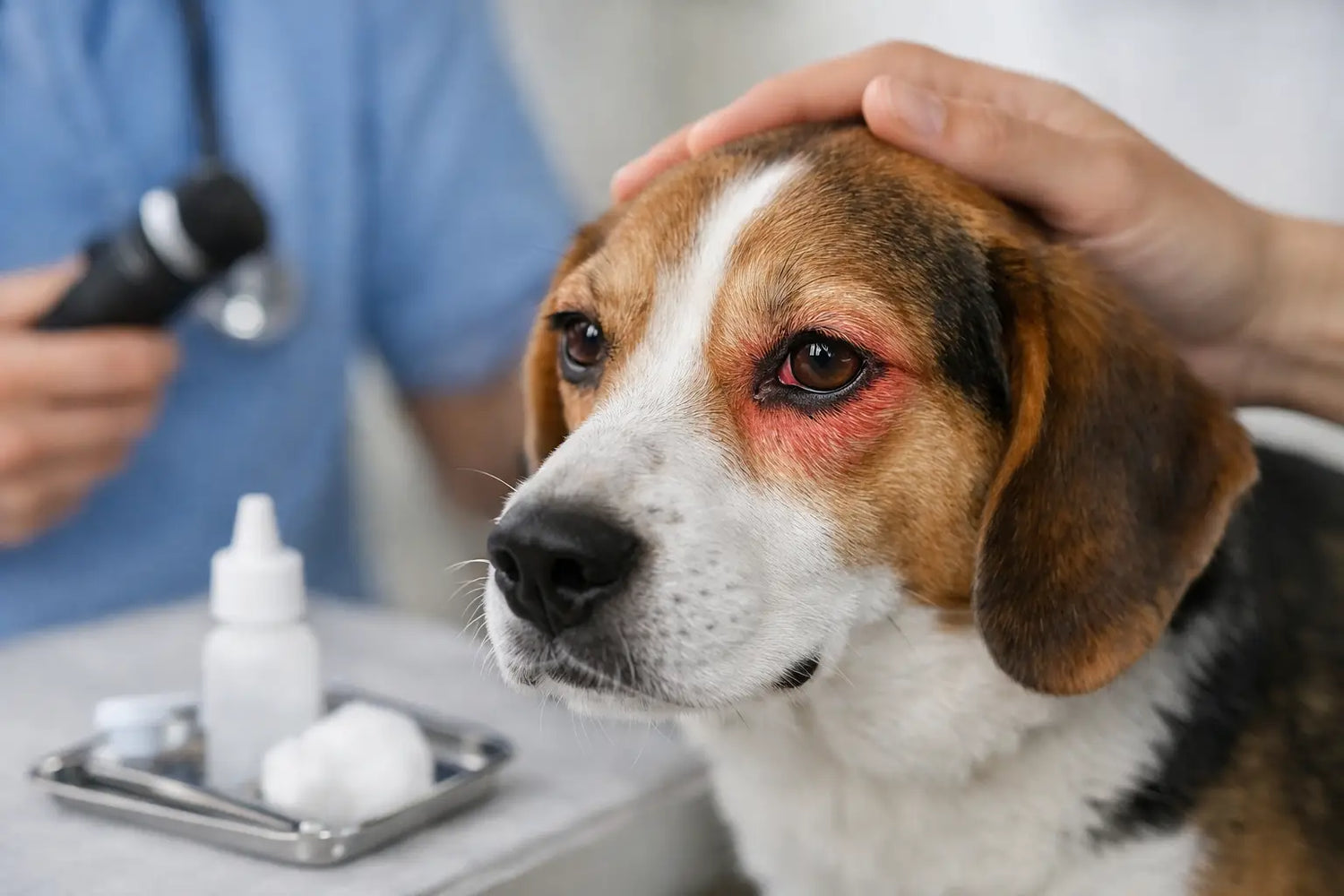
If you have noticed redness around your dog's eyes, you are not just observing a small cosmetic flaw. That area is delicate, thin, and constantly exposed to tearing, dust, pollen, hair, and secretions. When it becomes red, the dog is almost always sending a clear signal: there is irritation that needs to be managed well and quickly before it worsens.
Redness around dog's eyes: what it can depend on
Redness around the eyes can have many different causes. Sometimes it is a simple irritation from excessive tearing, other times it is related to conjunctivitis, environmental allergies, continuous rubbing with paws, presence of dust or plant residues, hair entering the eye, or insufficient cleaning of the periocular area.
In some dogs, the problem is favored by the shape of the muzzle. Brachycephalic breeds, with more exposed eyes, or dogs with marked skin folds and long hair on the muzzle tend to accumulate moisture, secretions, and impurities more easily. This creates an irritating environment that can redden the skin around the eyes and, if neglected, predispose to local inflammation.
There is also an aspect that many owners underestimate: the problem does not always start from the skin. Sometimes the area reddens because the eye tears too much. The skin, continuously wet, becomes irritated. In practice, the external redness is the visible consequence of an internal or periocular eye discomfort.
When the redness is mild and when a vet is needed
If the redness is mild, limited to the external skin, and the dog does not show obvious pain, you can start with proper daily cleaning using gentle products. However, if yellowish or greenish secretions appear, squinting, light sensitivity, persistent rubbing, marked swelling, or rapid worsening, a veterinary evaluation is necessary.
The same applies if the dog keeps the eye closed, whines when touched, or has very intense tearing from one side only. In these cases, corneal abrasions, foreign bodies, eyelash abnormalities, entropion, or infections that require specific treatment must be ruled out.
The practical rule is simple: reddened skin can be soothed, but the eye should never be treated improvisationally.
Signs that often come before true inflammation
Redness rarely appears alone. It is usually preceded by small warning signs: wet spots under the eyes, crusts, brownish halos from tearing, matted hair, frequent need to clean the area, and the dog rubbing on the couch or with its paw.
Intervening at this stage makes a difference. The fewer secretions stagnate on the skin, the less the skin becomes sensitized. This is why periocular cleansing should not be seen as an occasional gesture but as part of daily prevention, especially in predisposed dogs.
How to clean the eye area without worsening the problem
Here true delicacy is needed, not aggressive solutions. The dog's periocular area does not tolerate improvised cleansers, scented wipes for general use, or products designed for skin but not for the area near the eyes. Even rubbing too much, even with good intentions, can increase redness.
The ideal is to use an ocular cleansing solution formulated for pets, with soothing and well-tolerated ingredients, applied on a soft gauze. Clean from the inner corner outward, without pressing, removing secretions and residues. If there are crusts, it is better to soften them first with the solution and then remove them with slow movements.
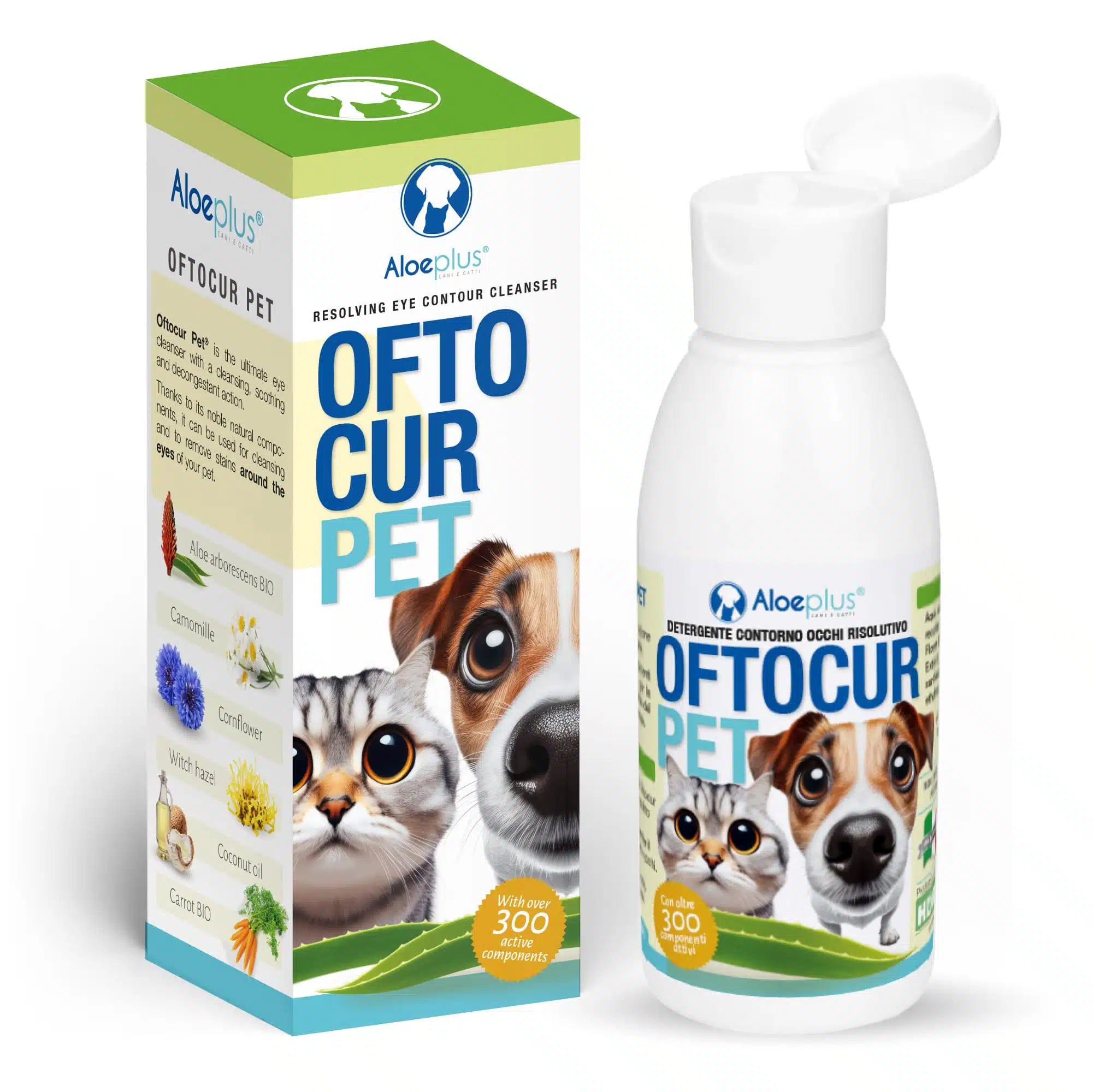
A dermo-functional product like Oftocur responds well to this need because it is specifically designed for gentle cleansing of the ocular and periocular area. The presence of aloe, chamomile, cornflower, and witch hazel makes it suitable to soothe and refresh an area that tends to irritate easily.
Aloe is known for its emollient and soothing action on stressed skin. Chamomile is traditionally appreciated for its calming effect. Cornflower is often used in formulations dedicated to eye wellness for its gentleness, while witch hazel is known for its softening and rebalancing action on mucous membranes and sensitive skin. In literature, several studies attribute a role to aloe polysaccharides in supporting skin repair processes and maintaining surface hydration; similarly, chamomile and witch hazel extracts have long been studied for their soothing potential in mild skin irritations.
Redness around dog's eyes and tearing: why they should be treated together
Many owners look for a remedy for redness but ignore the most frequent cause that maintains it: continuous moisture. If the hair stays wet for hours, the skin macerates, becomes sensitized, and is more exposed to irritation and superficial microbial proliferation.
For this reason, simply "cleaning when dirt is visible" often is not enough. Consistency is needed. In dogs with sensitive eyes or frequent tearing, cleansing can be useful even once or twice a day, always gently and always with a specific product. The benefit is not only aesthetic. A clean and dry area defends itself better and tends to redden less.
If the dog also has long hair around the eyes, it should be evaluated with the groomer or vet whether to trim it slightly. Reducing continuous contact between hair and the eye surface often limits both reflex tearing and irritation of the surrounding skin.
The natural remedies that make the most sense
When talking about the eye area, natural does not mean homemade. It means choosing functional, well-studied ingredients suitable for an extremely delicate area. In this context, aloe represents one of the most interesting active ingredients because it helps relieve stressed skin and maintain good surface hydration without weighing it down.
Chamomile and cornflower also have a long tradition of use in soothing formulations for the eye area. Witch hazel adds useful support when the skin appears easily congested. The difference, however, is made by the quality of the formulation: valid ingredients but included in a product not designed for periocular use can be inadequate.
For this reason, in daily management, it makes more sense to choose a specific solution to cleanse and soothe rather than DIY remedies. A formulation designed for dogs and cats reduces the risk of additional irritation and makes the routine safer.
What to avoid if the dog's eye area is red
The most common mistake is using human products, perhaps non-prescribed eye drops, generic cleansers, or pads soaked with scented substances. Another frequent mistake is cleaning with cotton that leaves fibers or insisting too much on the area trying to remove every stain at once.
Homemade non-sterile preparations should also be avoided. Infusions, homemade chamomile, or improvised solutions may seem harmless, but near the eye safety comes first. If the tissue is already irritated, it takes little to worsen the situation.
Finally, do not wait weeks hoping it will go away on its own. Mild redness may depend on a trivial cause, but if it persists, it means the irritant factor is still present.
A concrete routine to protect the periocular area
The best management is simple and consistent. Observe the eye every day, clean the area when secretions or moisture appear, keep the hair tidy, and intervene immediately at the first signs of irritation. During windy, pollen, or dusty periods, this attention counts even more.
For predisposed dogs, gentle cleansing with ingredients like aloe, chamomile, cornflower, and witch hazel can become a real daily support, not an occasional gesture. This is exactly where a solution like OftocurPet finds its practical usefulness: it helps cleanse, refresh, and soothe one of the most sensitive areas of the dog's face, with a targeted approach consistent with natural well-being.
Anyone who lives with a dog knows well: some irritations seem small until they become persistent. Taking care of the eye area with attention, the right products, and a watchful eye on clinical signs is one of the simplest ways to make your dog feel more comfortable right away.