
Article index
Taking care of the ears of our four-legged friends is essential to prevent nasty and annoying otitis.
In this article, taken from the Facebook live of Dr. Daniela Di Scala, we deal with otitis, how to recognize it and how to treat it with natural remedies.
We will see how to recognize the signals our friends give us, how to treat it and prevent it, where possible.
What is the ear made of?
Before talking about otitis, let's see how the ear structure is made.
It is divided into 3 main structures:
- the external structure is a parabola that helps amplify sounds and channel them towards the second structure
- the middle part is the resonance chamber of sounds, where vibrations turn into nerve signals.
- the inner part contains the hearing receptors, connected to those of balance which in turn send the signal to the central nervous system.
Our faithful friends have a hearing ability definitely superior to ours; they recognize our voice among many others.
Through the perception of sounds and their wonderful hearing, they can communicate and express their emotions and moods.[
But what is otitis?
Otitis, is an inflammation of the ear and can involve one or more parts of the ear and can spread from one to the other.
Just like any other part of the body, the ear can be subject to alterations and the delicate balance that holds these structures together is disturbed.
The function of the ear is compromised and it becomes inflamed, sometimes causing severe otitis.
A neglected external otitis, not recognized in time or poorly managed, can turn into middle ear infection or even, in the most severe and dangerous forms, into inner ear infection.
What are the favorable conditions for otitis?
The ear, with its “L” shape, is suitable for hosting bacteria, parasites, and moisture, a perfect environment for an infection or inflammation.
There are also some breeds that are predisposed to developing otitis.
Cocker spaniels, for example, have beautiful ears, but heavy and drooping, a fertile environment for bacteria and yeasts.
But even bulldogs with a narrow ear canal are predisposed to infections because their conformation tends to retain natural secretions inside.
Moreover, a series of concomitant diseases can involve the ear:
- hormonal processes
- allergies
- mites
- malassezia
- bacteria
Then there is the chapter on dermatitis, which can affect the ear secondarily.
How do you recognize otitis?
Our faithful friends give us warning signs:
- They shake their head
- They scratch their ears or seek relief by rubbing their head against objects
- They react aggressively when we try to touch their ears
- Unpleasant odor coming from the ears
There is a signal that must not be underestimated; it appears in the early stage of the problem: itching.
They start to show us a mild discomfort, which is itching.
What can we do to prevent it?
The first thing to do, especially if you have a puppy, is to teach them to be handled and touched.
“My dog is jealous of his ears” is something we often hear from our clients and those of Dr. Di Scala, but the truth is that our animals are jealous of every part of their body.
They need to get used to having their ears, paws, and nails handled, so they will be more docile during veterinary visits.
For example:
When returning from walks, carefully inspect your four-legged friend's fur and ears; the dreaded grass awns get into every part, and the ear is a very common area.
How do I clean my four-legged friend's ears?
✔️ Useful tips
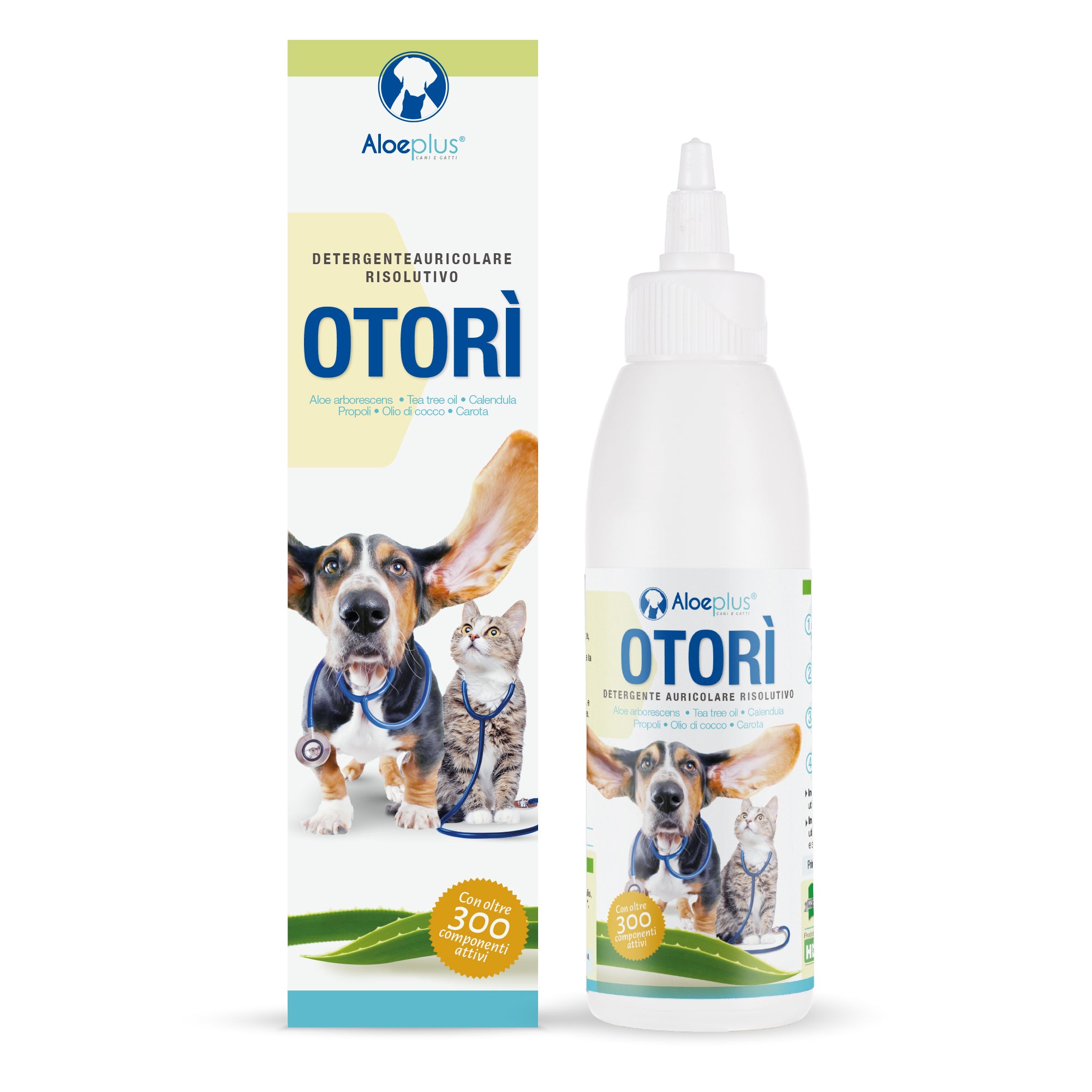
- Use specific and gentle products with a natural formulation to respect the ear’s structure and that do not release strong odors for them.
- After inserting the product inside, massage the base of the ear so that the product reaches deep inside.
- Use a cotton ball to remove the material present in the ear.
❌ Errors to avoid
- Avoid, if possible, using cotton swabs; it is not an absolute ban, but if not used correctly, they tend not to remove earwax but push it further inside the ear canal.
- Do not put unsuitable products inside the ear, such as hydrogen peroxide. Whitening the ear is not a sign of effectiveness; this remedy is totally ineffective and often worsens the situation.
How do I treat it?
We always recommend consulting your trusted veterinarian for a specific diagnosis.
Use natural products specially formulated for the care of your four-legged friend's otitis.
Avoid “do-it-yourself” products that often only make the problem worse.
Also, good prevention such as regular ear cleaning will definitely help you avoid severe forms of otitis and therefore the need to administer cortisone and antibiotics.